Run security operations on one graph
Six capabilities, one behavioral graph, nothing to install.
Anzenna gives security operations one place to work. The alert, the behavior behind it, the identity and data at stake, and the decision, all reasoned from the same picture.

Security operations, at a glance
- One page for the whole operation: insider risk, alert triage, behavior analytics, identity, data, and application posture, run together.
- Identity-first. Every signal resolves to a person, a peer group, and the data that person can already reach.
- Agentless. Read-only API connections to 130+ identity, SaaS, cloud, and endpoint sources, live in about fifteen minutes.
- Fewer alerts, and better ones. Around 90% fewer reach an analyst, and the ones that do arrive as a case file.
The queue grew, the team did not
Every product you added to see more of the environment added its own alert stream. Analysts now spend the day proving that almost all of it is nothing, and three things go missing in the process.
- Volume without meaningSeverity is scored per event, so a thousand ordinary sign-ins can outrank the one that came from someone with a resignation already on file.
- Signals in separate roomsIdentity, endpoint, SaaS, and data each hold a fragment. Nothing holds the sequence, so every case gets assembled by hand.
- Time spent on assemblyMost of time-to-resolve is not deciding, it is gathering context, and that is the part that wears a team down.
Six capabilities, one discipline
Each one stands on its own. Together they cover the working day of a security operations team, from an alert arriving to a decision being recorded.
Insider Risk
The departing engineer, the quiet exit, the last-week download. Anzenna reads intent from behavior, not from a keyword list.
Explore ↗ 02Alert Triage
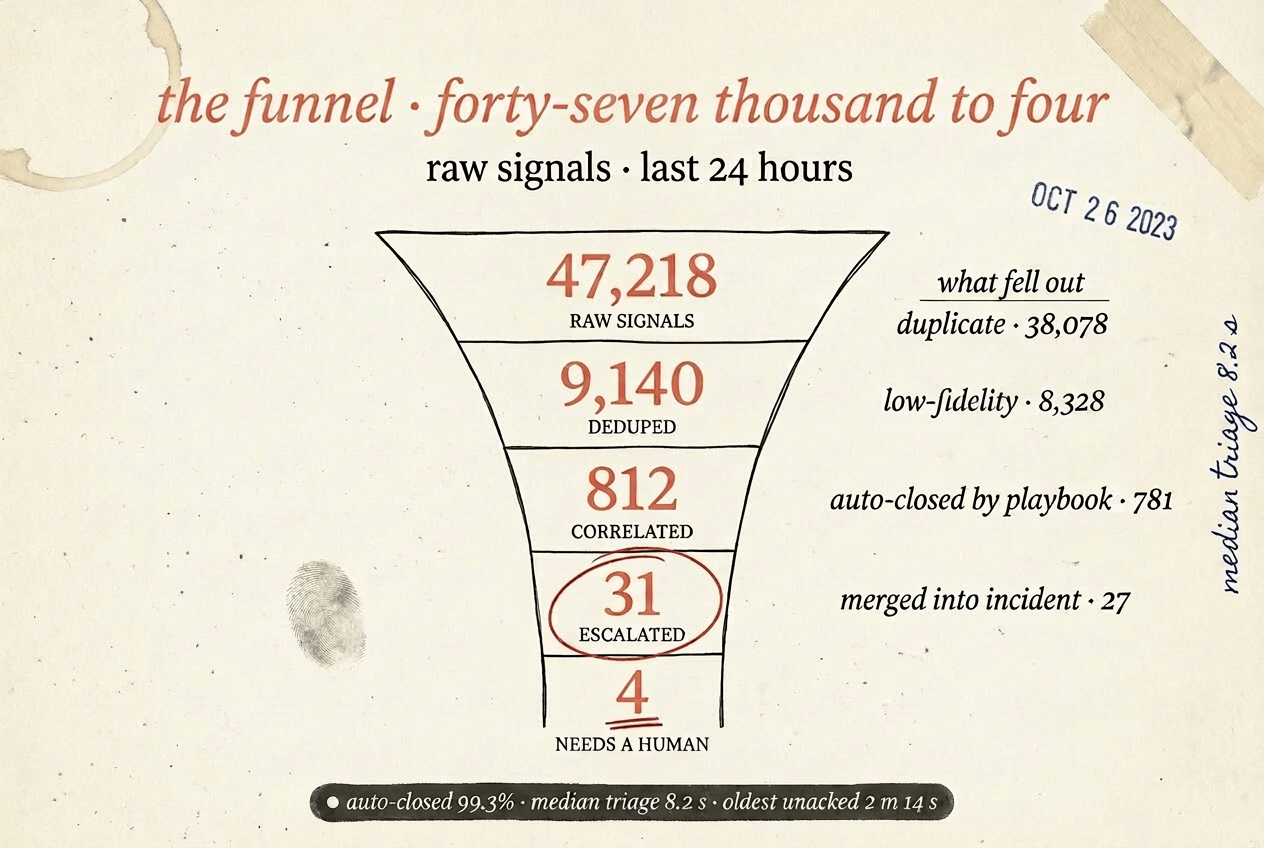
The queue de-duplicates, correlates and closes itself. What reaches an analyst arrives as a case file, not a raw alert.
Explore ↗ 03UEBA
Ninety days of normal, per person and per peer group, so the deviation that matters stands out from the rest.
Explore ↗ 04Identity Threats
Three thousand anomalous logins, two that were real. The graph knows which of your people that sign-in actually belongs to.
Explore ↗ 05Data & IP
A repo push to a personal account looks like work until you see whose account it is, and what week it is.
Explore ↗ 06Application Posture
Thousands of apps, tens of thousands of grants, and the one or two percent that actually hold risk worth your attention.
Explore ↗One graph under all six
Anzenna connects read-only to the identity providers, SaaS apps, cloud accounts, and endpoint tools you already run. From that metadata it builds one behavioral graph, and every capability on this page reads from the same picture.
-
Connect
Read-only API access to 130+ identity, SaaS, cloud, and endpoint sources, alongside the SIEM you already pay for. Nothing goes on a laptop.
-
Correlate
Ninety days of behavior resolve into people, peer groups, and the sequence a signal belongs to. Duplicates collapse, weak signals join up.
-
Decide
What survives arrives as a case file: the trigger, the evidence, a plain-language verdict, and one-click remediation, with an audit trail.
What that changes
| The question | SIEM and legacy UEBA | Anzenna |
|---|---|---|
| Why did this alert fire? | A rule matched a pattern | A person did something unlike them, and unlike their peers |
| Is this the same incident? | One alert per event, joined up by hand | Duplicates collapse before an analyst ever opens them |
| What is actually at stake? | The affected host or account | The identity, its access, and the data it can really reach |
| What did we conclude? | Notes in a ticket, if anyone wrote them | A case file with the evidence, the verdict, and the audit trail |
My team isn't firefighting anymore. They're investigating, deciding, resting. That's what security should feel like.
Your stack, unchanged
Fifteen-minute install. Read-only by default. No agents on endpoints.






Common questions
What does Anzenna cover under security operations?
Six capabilities on one behavioral graph: insider risk, alert triage, UEBA, identity threat detection, data and IP protection, and application posture. They share one baseline and one case format, so an investigation that starts in one of them ends in the same place.
Does Anzenna replace our SIEM?
No. Anzenna sits on top of the SIEM and publishes its findings back into it and over API. It reduces what you ingest and what your analysts open, rather than asking you to move your log estate.
How much noise does it actually remove?
In production, roughly 90% fewer alerts reach analysts, and the ones that do arrive as a case file rather than a raw event. Anzenna keeps the reasoning behind every suppression, so nothing is silenced without a record you can audit.
Do you need an endpoint agent?
No. Anzenna connects over read-only APIs to the identity providers, SaaS apps, cloud platforms, and endpoint tools you already run, and reads metadata only. There is nothing to install on laptops, most teams are live in about fifteen minutes, and Anzenna is SOC 2 Type II attested.
See your queue, in thirty minutes
Your environment, your identities, your alerts. No agents to deploy.