UEBA,
minus the noise.
Behavioral analytics that act, not just alert. Legacy UEBA waits for logs, fires on rules, and buries your team in false positives. Anzenna baselines every person and entity against their peers, then turns the anomalies that matter into investigated cases.

Legacy UEBA waits.
Traditional behavior analytics piece together logs, if you managed to ingest them, and anomalies, if you wrote the rules, long after the data has already left the building. By the time a flag fires, the moment is gone.
It treats every user the same and floods the SOC with statistical noise. Roughly half of the alerts are false, and the ones that matter are buried among them.
And it taxes the SIEM you already pay for: UEBA skew to ingest, license, and maintain. Behavior analytics should cut cost and noise, not add them.
Baselined against peers, not thresholds.
Anzenna learns what normal looks like for each person and entity against their peer group, by role, team, and tenure, then weighs live behavior against it, tied to identity, device, and history. An engineer cloning their own repo is normal; the same pattern from a departing contractor is not.
- Peer-group baselines, not static thresholds that age the day you set them.
- Weak-signal correlation across identity, endpoint, SaaS, and data, joined into one graph.
- Risk scores per employee and team, with the vulnerabilities to fix first.
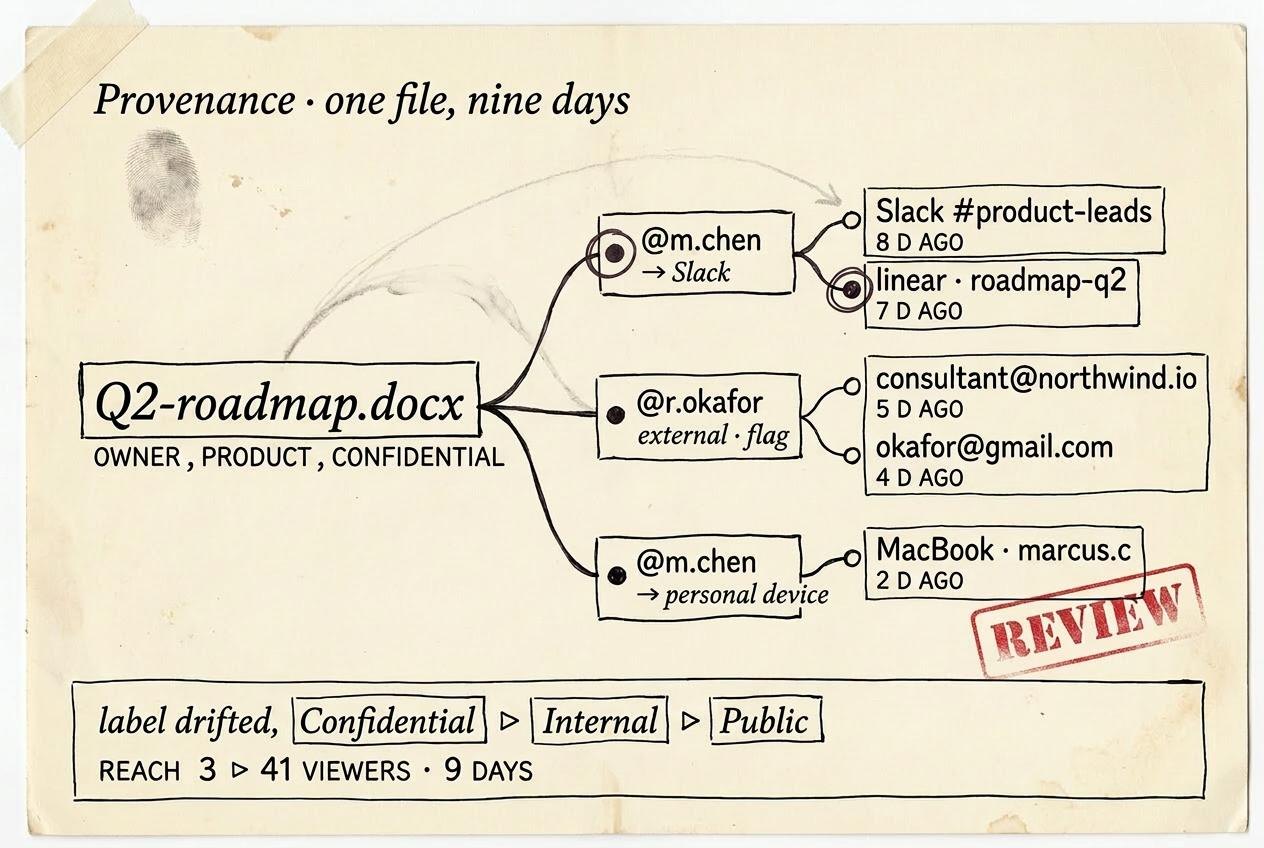
Three reads on the same behavior.
An anomaly is not a verdict. The same deviation means different things depending on who, and why.
A deviation that fits the person's role, peers, and history once you see the context.
Behavior pulling away from baseline, early and quiet, with no single line that screams.
A pattern that breaks baseline and matches known abuse, in the worst possible context.
A written case, not a statistical blip.
Anzenna surfaces the anomaly as a reasoned case, with the baseline, the peer comparison, and the identity behind it, not a red dot on a chart for an analyst to chase.
From raw logs to resolved case.
Anzenna delivers the behavior analytics UEBA promised, grounded in the same graph it uses for insider risk, agentless from day one.
Connect
Read-only API access across 130+ identity, SaaS, cloud, and endpoint sources. No agents, no log pipeline to build.
Baseline
Learn normal for every person and entity against their peer group over a rolling window, instead of hand-tuned thresholds.
Correlate
Join weak signals across identity, endpoint, SaaS, and data into insights no siloed tool can produce.
Resolve
Surface the anomaly as an investigated case, routed to SIEM, Slack, email, or Jira, with a full audit trail.
Rules and thresholds age. Behavior in context doesn't.
Legacy UEBA treats every user the same and bills you twice, once to ingest the data and once to tune the rules. Anzenna reasons over identity, peers, and behavior, so the signal stays accurate and the noise stays down.
Common questions.
What is UEBA?
Does Anzenna replace our UEBA?
How is it different from legacy UEBA?
Does it work with our SIEM?
Govern AI end to end.
Behavior analytics is the foundation. The same graph powers insider risk, alert triage, and identity threat detection.
The full picture, in one place: see the security operations overview →
Behavioral analytics, at a glance.
- User and entity behavior analytics (UEBA) grounded in identity and context, agentless.
- Continuous risk scores per person and entity across your stack.
- Surfaces the behavior that matters as a reasoned case, not a raw anomaly.
Your stack, unchanged.
Fifteen-minute install. Read-only by default. No agents on endpoints.