The new surface,
visible.
Shadow AI usage, rogue agent behavior, and AI-enabled exfiltration. The new attack surface, made visible by a platform built to watch it.

Shadow AI is already in the building.
Forty-seven employees touched an unapproved AI tool last week. Twenty-one are using personal accounts on managed devices. Eight tools you've never heard of are flagging signals this morning.
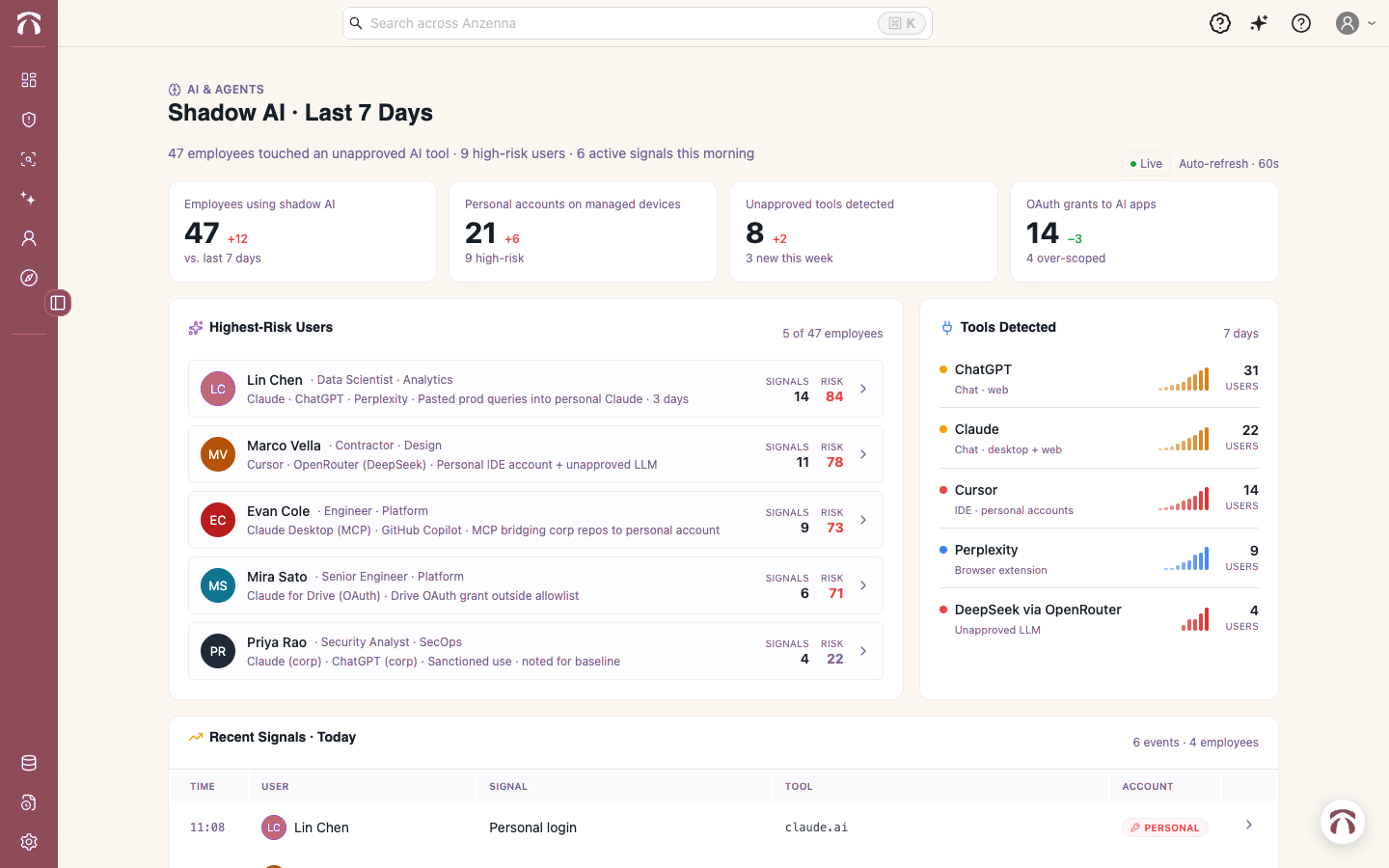
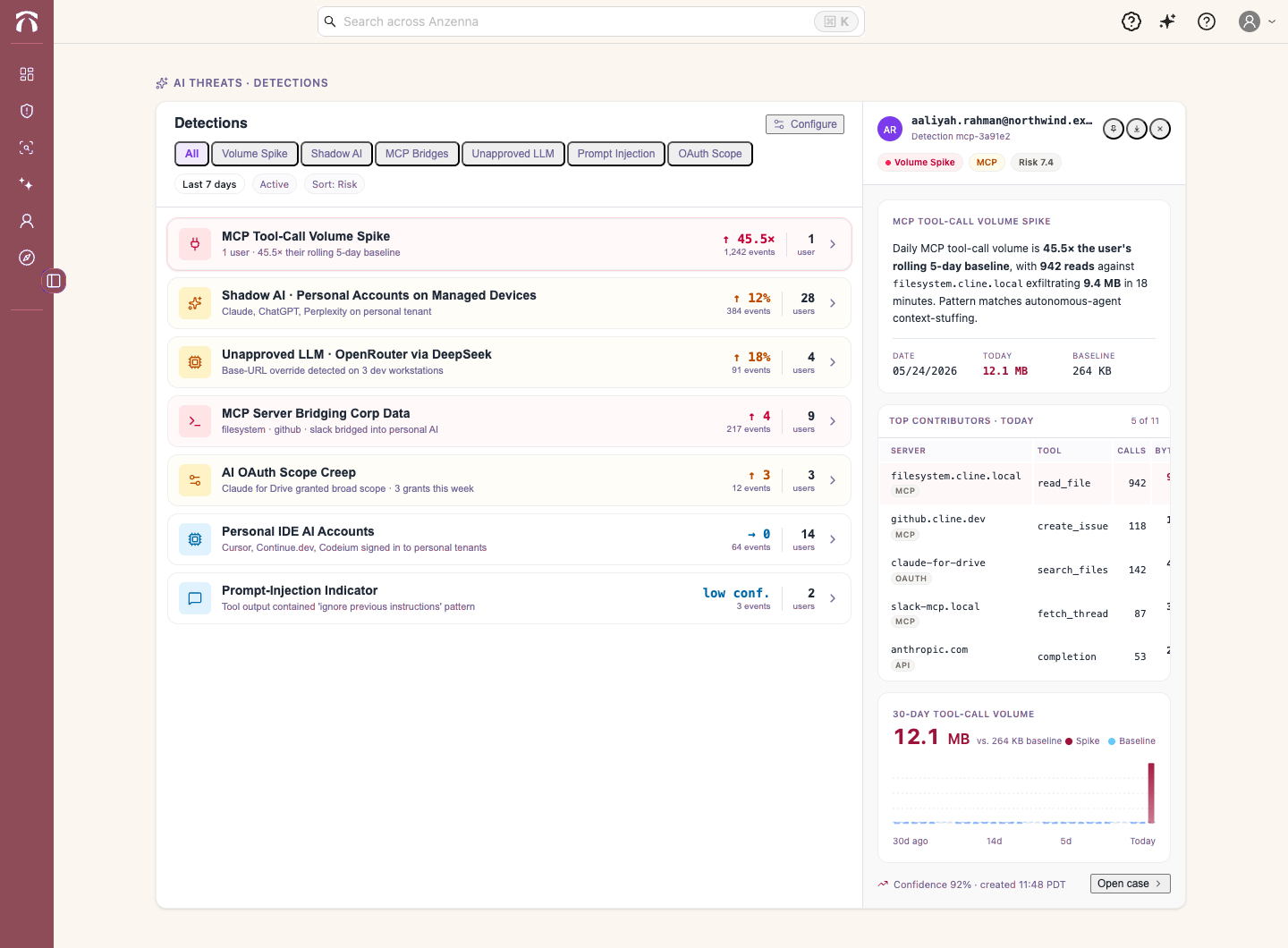
An inventory tells you what. Not who, or why.
AI tools arrived faster than any security program was built for. But listing what's installed is the easy part. The hard question is the one every breach starts with: is this normal for this person, on this team, right now?
Agents nobody provisioned
Claude, Cursor, Copilot, Cline, and a dozen peers arrive through self-service installs. Each carries its own permissions. None of them check in with security.
A surface that compounds
Every agent is a host for plugins, skills, hooks, CLIs, and IDE extensions, each adding reach the agent never shipped with.
MCP servers wired to anything
Pulled from public registries and handed filesystem, shell, and network access, usually before anyone asks what they can reach.
Credentials in the open
API keys, database URLs, and private keys sit in config files that any loaded agent can read and any prompt can leak.
Permissions granted by default
A single Bash(*) or Write(*) rule hands an autonomous process the whole machine, with no human in the loop.
No one behind the activity
When data starts moving, the missing piece is the person and the pattern: whose machine, what they normally do, and whether this fits.
How we see it.
Weaponized AI
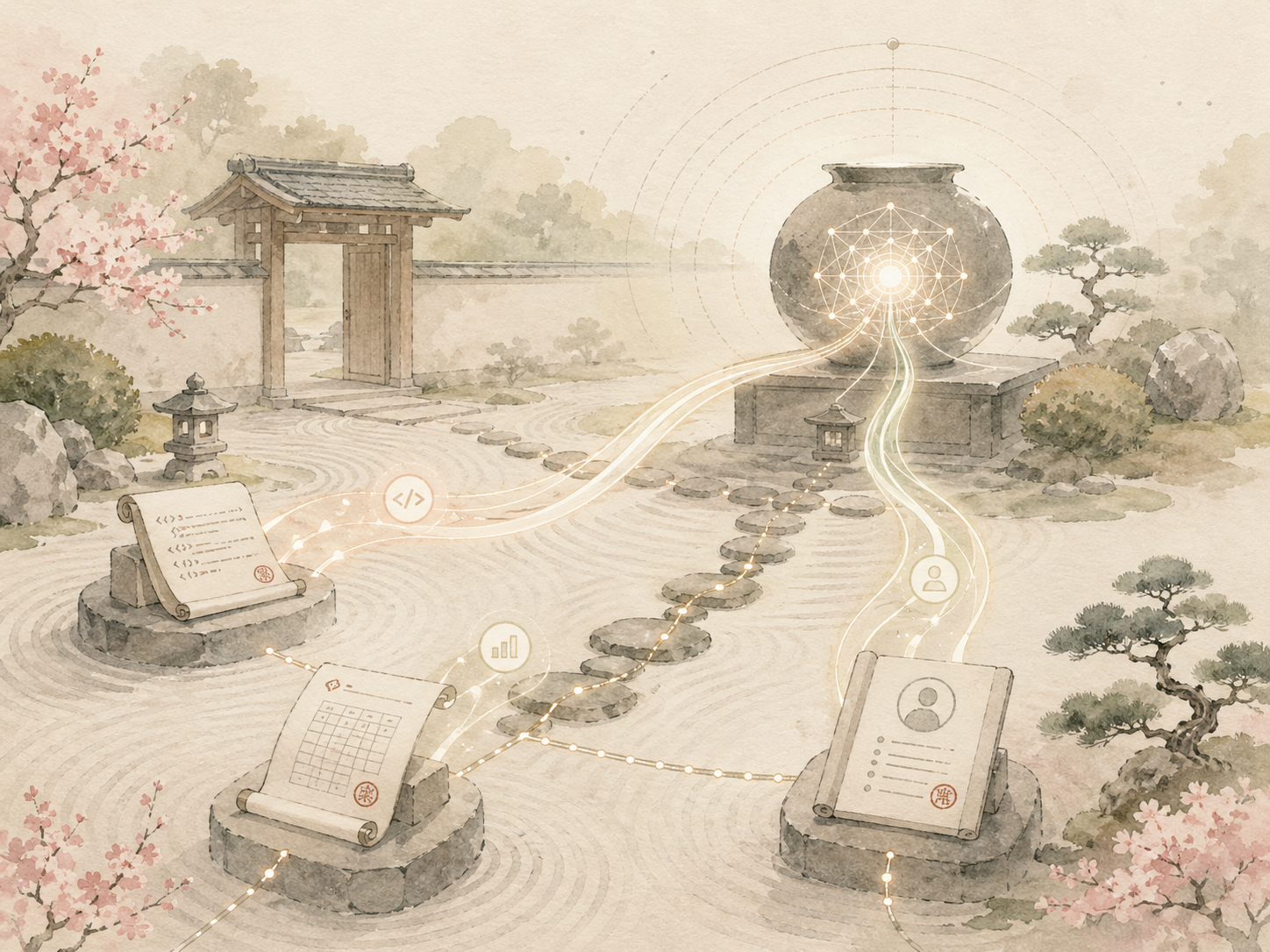
Employees are feeding AI systems with organizational data outside managed channels: source code into ChatGPT, financials into Claude, customer records into AI extensions. Anzenna captures these AI data flows and ties them back to employee identity, behavioral history, and surrounding context through automatic investigations. Security teams can see exactly what is entering AI, and when it crosses the line.
Agent gone rogue
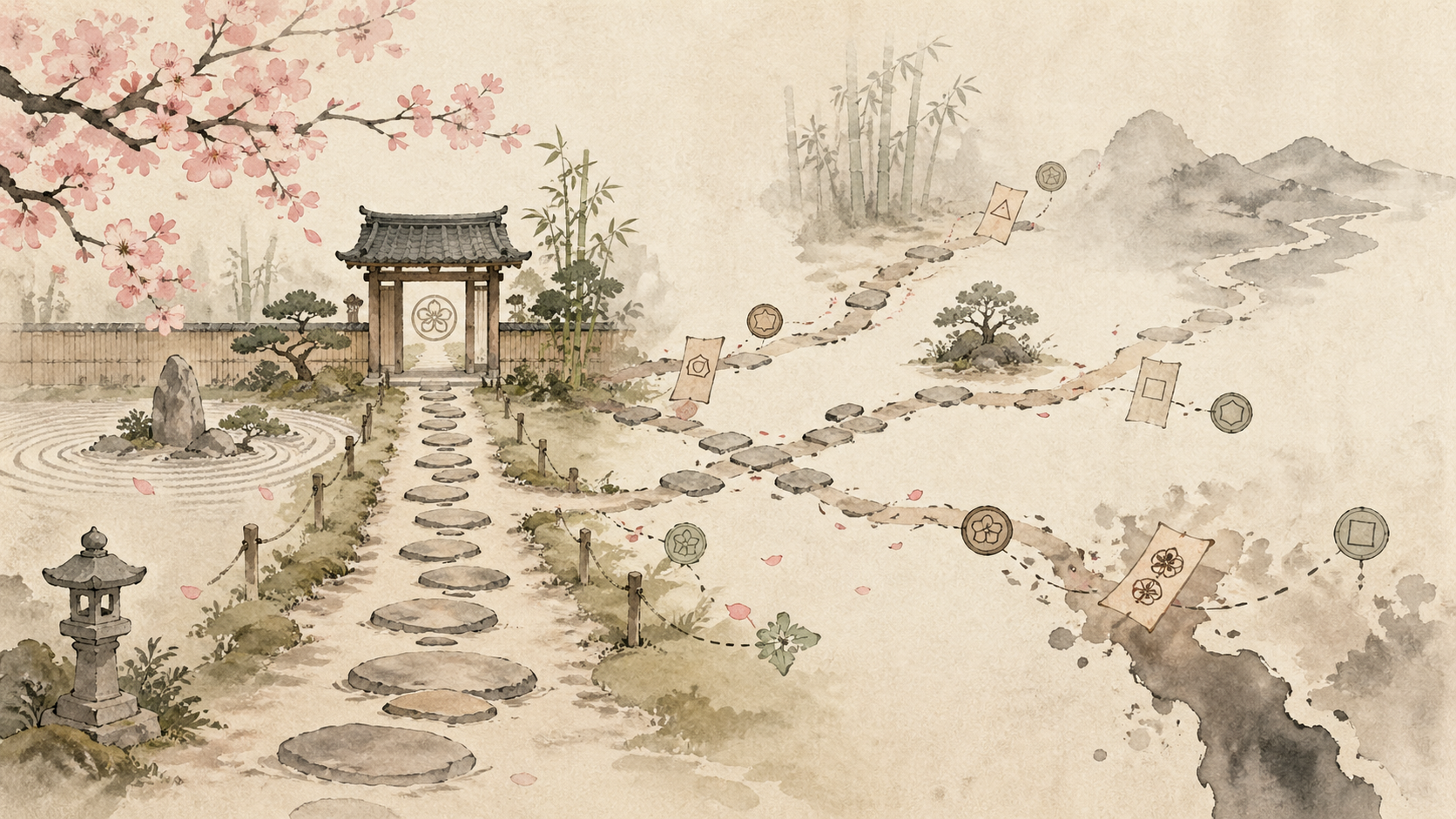
AI agents request broad scopes that give them read and write access far beyond what most humans ever hold. Anzenna flags risky scopes, MCP server installs, and agent activity that begins to move beyond its intended role. What looks harmless at first can widen quietly. Anzenna makes that drift visible.

AI at the controls
AI agents can be granted write access to production systems: committing code, modifying databases, sending emails, and triggering workflows. Misconfigured or compromised AI is not only a data risk. It is an operational risk. Anzenna tracks the configurations and behaviors that can turn agent access into business disruption.
The whole AI surface, tied to the person behind it.
Anzenna reads every AI artifact across your fleet through the EDR, MDM, identity, and developer-tool integrations you already run. Then it does the part that matters: it connects each one to an employee, a device, and a pattern of behavior.
AI Agents
The assistants people actually run, from Claude to Cursor to Copilot, each mapped to the employee and device behind the install.
MCP Servers
Every connector graded official, community, or unknown, with the filesystem, shell, and network reach it was handed.
Extensions
AI extensions across VS Code, Cursor, JetBrains, and the browser, weighed against your allowlist.
Skills
Custom skill packs loaded into an agent, and the standing instructions they inject into every session.
Plugins
Third-party add-ons that extend what an agent can do, including the ones that arrived without a ticket.
Secrets
API keys, database URLs, and private keys exposed in config, flagged wherever an agent or plugin could read them.
Hooks
Pre-prompt, post-tool, and event hooks, with the command each one fires and the moment it runs.
CLIs
Command-line tools and wrappers that drive agents outside the IDE, where most monitoring never looks.
The catalog grows with the ecosystem. As new AI artifact types appear, Anzenna learns to see them.
See clearly. Weigh truly. Act gently.
Discovery is table stakes. What changes the outcome is what Anzenna does next, the same worldview behind every Anzenna investigation, pointed at AI.
Behavior
Measured against peer-group baselines
Context
Tied to identity, device, and history
Intent
What the action was actually for
A written case, not another alert.
See clearly.
Every agent, connector, and credential pulled into one living graph of people, devices, and apps. Weak signals that mean nothing alone, read together.
Weigh truly.
Behavior judged against peer-group baselines, not static rules. An engineer wiring an MCP to their own repo is normal. The same agent reaching across the org is not. Anzenna knows the difference.
Act gently.
When something crosses the line, an Investigation Agent writes the case: evidence, narrative, and a proposed response, routed to where your team already works. Human in the loop, audited end to end.
Inventory is the floor. Runtime is the test.
An MCP server can be approved on Monday and behave like an exfiltration tool on Thursday. Anzenna learns what normal looks like for each agent and the person running it, then weighs live behavior against that baseline.
-
i
Baseline
Anzenna learns each agent's normal tool-call volume, targets, and data movement over a rolling window, per device, per user, and against the employee's peer group.
-
ii
Detect
Sudden spikes, new high-risk targets, and bursts of data movement are scored against that baseline and matched to known abuse patterns.
-
iii
Investigate
A confirmed signal opens a case the Investigation Agent has already written: the evidence, the identity behind it, and a recommended response, routed to SIEM, Slack, email, and Jira. Read-only by default.
The events are logged. The meaning isn't.
Your endpoint and developer tools already emit a stream of agent activity: a prompt sent, a file read, a connection opened, a tool invoked. On their own, those lines are verbs without a subject. Anzenna reads that stream through the integrations you already run and supplies the part no log records, the intent, the context, and the decision behind each action.
No new agent. We read the stack you run.
Anzenna doesn't add another daemon to your endpoints. It reads the AI surface through the EDR, MDM, identity, and developer tools already deployed: read-only, metadata only, live in fifteen minutes.
How it sees
- 130+ integrations across Okta, Google Workspace, Microsoft 365, GitHub, CrowdStrike, Jamf, and Slack.
- No endpoint agent to deploy, package, or maintain.
- A unified graph of people, devices, apps, and the AI they run.
- Peer-group baselines, not static thresholds.
- Weak-signal correlation across identity, endpoint, and SaaS.
- Live in fifteen minutes, with signal on day one.
Built to be trusted
- SOC 2 Type II attested.
- Read-only by default. Anzenna observes; it doesn't take the wheel.
- Metadata only. Not your source, not your prompts.
- Secrets redacted before they ever reach Anzenna.
- Strict tenant isolation at the query layer.
- Every agent decision reviewable and audited end to end.
Your tools each hold a fragment. Anzenna holds the story.
Anzenna doesn't replace what you run. It reads those tools and connects the fragments none of them can see on their own.
We had no insights into our AI usage and Anzenna was able to provide us with a comprehensive visibility layer.
Your stack, unchanged.
Fifteen-minute install. Read-only by default. No agents on endpoints.







AI posture management, at a glance.
- Governs your whole AI surface: copilots, autonomous agents, MCP servers and extensions.
- Discovers shadow AI and rogue agents and maps the data each can reach, agentlessly.
- Coach, block or revoke risky AI usage in one click.
AI posture management, answered.
What is AI posture management?
The discipline of governing your entire AI surface, the copilots, autonomous agents, MCP servers and extensions in use, the data they can reach and the people behind them, and continuously managing the risk that surface carries. Anzenna does it agentlessly.
What is an AI surface?
Every place AI touches your organization: sanctioned copilots and the shadow AI tools employees adopt on their own, autonomous agents, MCP servers, browser and IDE extensions, and the identities and data connected to each.
How does Anzenna discover shadow AI and rogue agents?
It correlates identity, SaaS, browser and endpoint signals to find the AI tools and agents in use, sanctioned or not, maps the access and data path each one holds, and flags risky usage with full context.
Does it cover MCP servers and AI extensions?
Yes. MCP servers, AI browser and IDE extensions, and connected apps are discovered and assessed as part of the same behavioral graph.
Is it agentless?
Yes. Anzenna connects through APIs across your identity, SaaS, cloud and endpoint systems, with nothing to install.
Ready to see it on your data?
Thirty minutes. Your environment, not our slides.
Request a walkthrough ↗