Anzenna
In security, seeing what’s happening is everything. But getting that visibility? It’s usually a pain. You install clunky software on every laptop, slow down performance, raise privacy concerns, and waste hours managing it all.
That might be fine for some threats, but not for insider risk. The reason? Insider threats already have access. They’re employees, contractors, or partners who look like everyone else. You don’t need more noise or roadblocks. You need clarity without the accompanying chaos.
That’s why agentless security is a game-changer for insider risk management.
Agentless Isn’t Just Easier. It’s Smarter.
Let’s be honest: installing agents on every device was never fun. In today’s world it’s even more complicated. People work from anywhere, they sometimes use their own laptops, and they rely on various cloud tools. Installing agents across the entire attack surface is just not feasible for many organizations.
Agentless security flips the script. What is it actually? In the old days, we used to install ‘stuff’ (i.e. agents) on machines. Agentless security works in a different way. It connects directly to systems you already use. These systems can be Google Workspace, or Microsoft 365, or Okta, and others. Then, the agentless security quietly watches, behind the scenes, for risky behavior.
Why not continue to use agents? Here are a few reasons:
1. They’re hard to roll out.
Installing agents across thousands of devices? That takes forever. And IT teams often push back because of the hassle.
2. They miss a lot.
If someone logs in from a personal device or uses a cloud app, traditional agents may not catch it. That’s a big blind spot for insider risk.
3. They increase overhead.
Agents can eat up system resources, fiscal resources, and intangibles like the time it takes IT and security teams to install and maintain agents.
4. They hurt trust.
People don’t like feeling watched. Agent-based tools can feel creepy—hurting the company culture you’re trying to protect.
Why Agentless Works Better for Insider Risk
Insider threats don’t act like external threats. They don’t set off alarms. They work quietly, sometimes without even realizing they’re doing something wrong.
That’s why agentless tools like Anzenna are so powerful. Here’s what you get:
- No installs, no slowdowns.
You get instant visibility by connecting directly to systems your team already uses. - Covers everyone.
Your employees or contracts use their private phone instead of the company laptop? No issue, it doesn’t matter. Agentless tools see it all by looking at centralized data, not individual devices. - No lag, no drama.
There’s absolutely no slowdown in performance. Hence, no need for your employees, contracts or partners to disable anything. - Respects privacy.
Instead of spying on screens or logging every keystroke, agentless tools focus on patterns and context—what people are doing, not how many clicks they make.
What Anzenna Brings to the Table
At Anzenna, we didn’t just strip out the agent—we rethought how insider risk should be handled from the ground up.
Here’s how we do it:
- Connect once. Watch everything.
We plug into your core systems — like Google, Microsoft, Okta, GitHub — and start working immediately. No installs, no performance issues. - Smart behavior tracking.
Our AI watches for unusual behavior. Is someone suddenly downloading a ton of files? Is access behavior changing before someone resigns? We pick up on those signals fast. - Real action, not just alerts.
We don’t just throw alerts at your team. We help guide the response — whether it’s a coaching moment, access restriction, or something more serious. - Built to scale.
Are you a 50-person startup? And what about an enterprise with 50,000 employees? It doesn’t matter. Anzenna works the same, you won’t need to put in any extra effort.
The Bottom Line
Agent-based security feels like yesterday’s solution. It’s slow, invasive, and clunky. Agentless is the opposite—simple, smart, and invisible. And with insider risk rising fast, you need a solution that actually works without getting in the way.
Security should be everywhere, all the time—not just on the “right” devices.
Want to see how Anzenna can help you manage insider risk without the mess? Let’s talk. Schedule a demo today.
A common thread in breaches at companies like Coinbase, MGM, Tesla, Uber, and Disney? Insiders!
The Rising Cost and Impact of Insider Threats
Insider security breaches have become a costly and frequent reality for enterprises. Recent studies show that insider-led incidents are increasing in both frequency and financial impact – $400 million for the most recent Coinbase breach. Between 2020 and 2022, the percentage of companies experiencing more than 20 insider incidents per year jumped to 67% (from 53% in 2018). The annual average cost of these incidents has surged accordingly – from an estimated $8.3 million in 2018 to $16.2 million in 2023. By 2025, this figure climbed even higher, reaching $17.4 million per year on average. These numbers underscore that insider threats are not slowing down but actually increasing and broadening in scope with AI and are straining security budgets and resources worldwide. For context, one global report found the total annual average cost of an insider threat incident sits at $15.4 million, with negligent insiders accounting for the largest share of that expense.
However, not all insider threats are malicious spies or disgruntled employees. In fact, the majority are due to simple mistakes and carelessness. Over half (56%) of insider incidents stem from employee or contractor negligence, far outpacing those caused by malicious insiders (26%) or stolen credentials (18%). In other words, well-meaning staff who inadvertently violate security policy or mishandle data are often the weakest link. Everyday errors like misaddressed emails, improper document sharing, or failing to secure sensitive files can lead to serious data leaks. From the 2024/25 example of a Disney employee inadvertently installing a fake AI app that stole 1.1 TB of data to the 2022 Pegasus Airline exposure of 23 million files, ~6.5TB of data when a system administrator accidentally misconfigured a cloud storage bucket, leaving flight charts, crew PII, and even source code publicly accessible, it all points to insiders. Thankfully discovered by researchers before attackers could exploit it, the Pegasus Airline incident still violated data protection laws and highlighted how a single configuration mistake can put thousands at risk. The global scope of such cases – from a Turkish airline’s cloud leak to an employee in London emailing the wrong client list – shows that no region or industry is immune to insider mishaps.
The business impact of these threats goes beyond IT damage; it hits the organization’s reputation and bottom line. Simple mistakes like sending sensitive information to the wrong recipient are alarmingly common – 17% of employees admit to doing so. Such errors have tangible consequences: roughly 29% of companies report losing customers due to an employee’s email mistake or data leak. Over 60% of security issues involve a human element in some way, whether it’s a careless mistake or deliberate wrongdoing, and nearly half of all breaches originate from inside the organization.
These statistics drive home a clear message for CISOs and security leaders: insider risk is a pervasive, expensive problem, and it’s often the inadvertent missteps – not just the headline-grabbing malicious betrayals – that cause the most headaches.
Why Traditional Tools Fall Short for Insider Risk
Traditional security tools have long been the go-to for protecting data, but they were never built with insider behavior in mind. Data Loss Prevention (DLP) systems, Security Information and Event Management (SIEM) platforms, and Cloud Access Security Brokers (CASBs) each play important roles in a cybersecurity program – yet when it comes to insider threats, they leave critical gaps unaddressed. These legacy solutions excel at enforcing policies or aggregating technical events, but they lack the human context and continuous behavioral analysis needed to catch subtle signs of insider risk. Below, we examine why these tools often prove insufficient against today’s insider threat challenges:
- DLP – Protects Data, But Misses Intent: DLP solutions monitor and block sensitive data exfiltration based on content triggers (keywords, patterns, file types). They are like locks on the doors – effective at stopping clearly unauthorized transfers – but blind to intent and authorized misuse. If an employee with legitimate access decides to steal or mishandle data, traditional DLP might not raise any alarm because no policy was technically violated. DLP focuses on what data is moving, not why. It can’t tell if a normally trustworthy support employee is downloading an unusually large number of confidential files or slowly siphoning information over time. In short, DLP “focuses on data, not the behavior or intentions behind a user’s actions”, and thus an insider with valid credentials can abuse access without DLP recognizing the threat. The tool might flag a file being emailed out, but it won’t discern whether that was a careless mistake or a malicious exfiltration – and that context makes all the difference. In addition, DLP does not cover all elements of insider risk. E.g. Disney was hacked because an employee inadvertently downloaded a fake AI app which stole vast amounts of data. A DLP will not catch this type of insider threat.
- SIEM – Lots of Logs, Little Insight: SIEM platforms aggregate logs from across the network (VPN, servers, firewalls, etc.) to detect suspicious events, often using correlation rules. They are invaluable for spotting known attack patterns and compliance reporting. However, SIEMs are fundamentally event-driven and reactive – they alert after something bad has already happened. A SIEM will dutifully log an unusual login or a large database query, but it typically lacks user-behavior baselining to connect the dots across multiple subtle actions. Security teams end up wading through a “massive haystack” of alerts and log data, trying to find the needle that signals an insider incident. By the time a pattern is clear (for example, that Bob from finance has been accessing files he never touched before and emailing them out), the damage may be done. SIEMs also suffer from alert fatigue – they generate so many alerts that real insider warning signs get buried in noise. They catch discrete anomalies (a single forbidden access), but cannot easily track slow-burn behavioral deviations that unfold over weeks or months. In sum, SIEM provides a fragmented, after-the-fact view of insider activity, when what’s needed is continuous monitoring that could predict and prevent risky behavior. SIEMs also require the customer to aggregate all the required data, pay by data volume and build custom queries looking for all the badness. This significantly increases the cost and resourcing needs. Despite that, SIEMs do not catch advanced exfiltration such as an employee moving company source code to their personal accounts/devices without false positives.
- CASB – Cloud Control with Blind Spots: CASBs are either agent based or require traffic to be proxied through them and are aimed at tackling the explosion of SaaS usage and shadow IT, acting as a gateway to monitor and enforce cloud application policies. They shine at identifying unsanctioned app use and enforcing data policies in the cloud (e.g. blocking an upload of a customer list to personal Google Drive). This is useful for compliance – ensuring, for instance, that data in cloud apps is not shared publicly or that sensitive info is encrypted. However, CASBs are inherently focused on cloud traffic; they may miss risky activities happening elsewhere, such as on endpoints or via off-network channels. If an employee bypasses corporate cloud platforms entirely – say by using a personal email or an unauthorized device – a CASB might not see it. Additionally, while CASBs can flag anomalies within cloud usage (like an abnormal number of file downloads), they don’t correlate that with the user’s broader behavior outside the cloud. In today’s decentralized environments, data moves fluidly between cloud apps, local devices, and external collaborators. A tool limited to cloud boundaries can still leave visibility gaps where insiders might slip through.
Insider Risk is not just a traffic or data problem but also a behavior problem which is left unaddressed.
Ultimately, these traditional tools each operate in silos (one watching data egress, another watching network events, another EDR alerts, another cloud apps ..) and they “focus on event logs, and data protection without understanding the user behavioral context or joint insights across these silo’ed tools”. They were not designed to piece together the nuanced mosaic of human behavior across an organization. As one CISO we interviewed aptly put it, adding more point tools doesn’t automatically improve security because “these tools can only report on what they can see – they don’t know what they’re missing”. This limitation results in an “illusion of visibility”: security teams feel they have many bases covered, yet the subtle precursors of an insider incident (like a disgruntled employee’s changing file access habits) go unnoticed. For instance if an employee has access to sensitive data and has had their machine infected with malware “n” times in a given period of time is missed. If security teams know that information, they can automatically de-provision access as it is likely that the attacker is trying to compromise the employee to get access to sensitive data. Modern insider risk management requires moving beyond this patchwork of point solutions and looking at user behavior holistically, finding those toxic combinations that can really cause serious breaches.
The Behavioral Red Flags Conventional Security Misses
What exactly are those subtle insider signals that tend to slip through the cracks of legacy security tools? In practice, dangerous insider activity often manifests as small deviations in normal behavior rather than blatant rule violations. Conventional tools that lack user behavior analytics will miss many of these warning signs. Here are some common behavioral indicators and context clues that can precede insider incidents but are typically overlooked by traditional monitoring:

- Unusual Access Patterns: Employees usually develop predictable routines in the data they access and the systems they use. A classic red flag is when a user suddenly accesses data outside their typical purview or at odd hours. For instance, an engineer who normally works on Product A begins downloading large volumes of data from Project X (which they never touched before), or an employee signs in remotely at 3 AM and proceeds to query confidential databases. A SIEM might not flag off-hour logins if they use valid credentials, and a DLP system won’t object if the data isn’t explicitly classified as sensitive. But such behavioral deviation – accessing new, sensitive resources beyond one’s role, especially on a strange schedule – could indicate insider reconnaissance or data theft in progress. Modern insider risk tools look for these anomalies against a user’s baseline, whereas traditional tools treat each access in isolation.
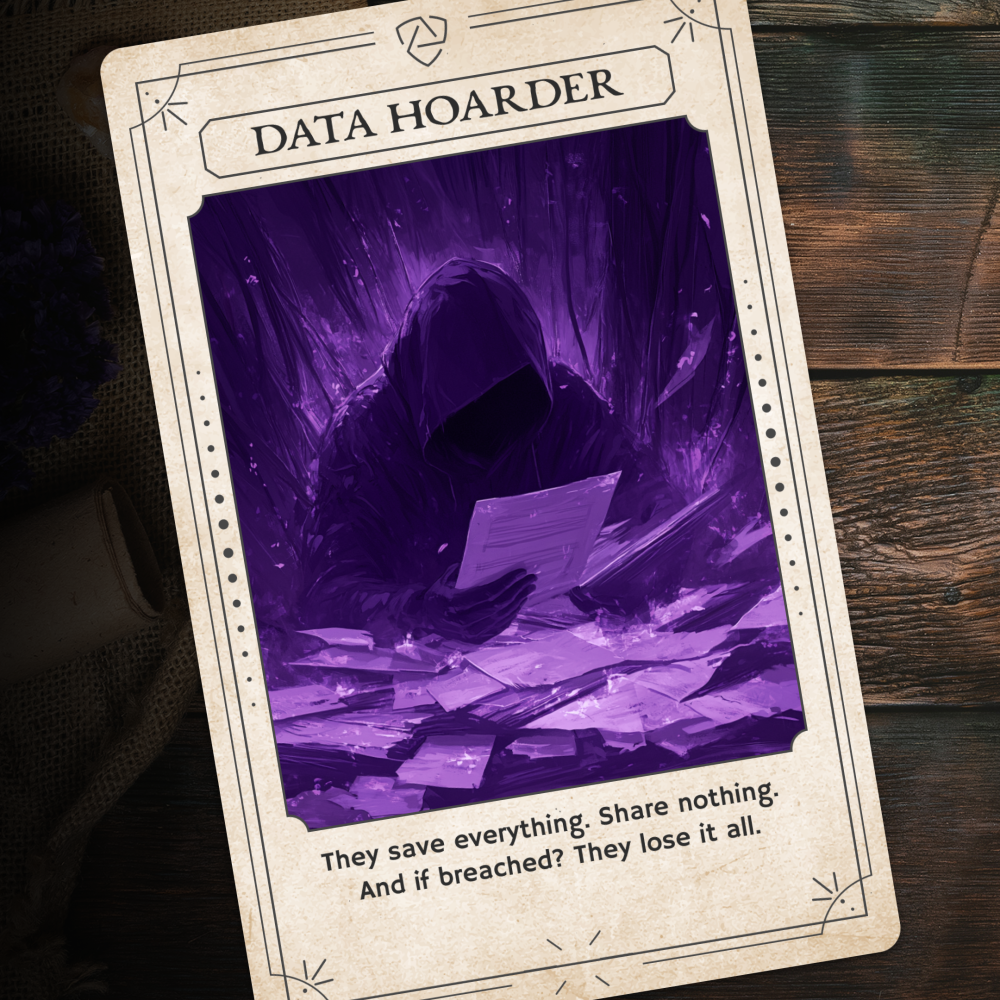
- Data Hoarding or Drip Exfiltration: Rather than a single large data dump (which DLP might catch), insiders with ill intent often exfiltrate data in smaller pieces or simply collect far more information than usual over time. For example, an employee might start downloading unusually large quantities of files from SharePoint over several weeks, or incrementally forwarding emails with attachments to their personal account. Each individual action might appear authorized (and thus not trigger DLP), but the trend is highly irregular for that person. Conventional security solutions aren’t aggregating activity over time to notice that user X transferred 5× their normal data volume this month. Behavioral monitoring would flag a “volume anomaly” or sudden spike in data access that warrants a closer look, distinguishing a potential insider threat from routine work.
- Circumvention of Controls: Negligent insiders sometimes bypass security controls in small ways that accumulate risk. For example, an employee might repeatedly use unapproved apps or personal USB drives because it’s convenient, even if policies forbid it. A CASB might catch some unauthorized cloud apps, but users often find ways around corporate monitoring (using unsanctioned devices, encrypted messaging apps, etc.). Similarly, someone might try to disable or pause endpoint monitoring agents or cover their tracks in log files. One single instance might be chalked up to a glitch, but patterns of policy bending – like frequent attempts to send files via forbidden channels or consistent use of workarounds – are signals of an insider who is either unaware of policy or intentionally ignoring it. Traditional tools in isolation might block each attempt without connecting the dots that a particular user is persistently trying to go around security, which is itself risky behavior.
- Emotional or HR Indicators Coupled with IT Activity: Often, the precursors to an insider incident are not purely digital. Human factors such as job dissatisfaction, policy grievances, or sudden changes in demeanor can foreshadow malicious intent. For instance, a salesperson who just got word of a layoff might begin downloading the customer database. Security tools focused only on IT events won’t catch the context of why that person’s behavior changed. While it’s a delicate area, modern insider risk programs sometimes incorporate inputs from HR (departing employee lists, performance issues) and even communication monitoring (public Slack or email sentiment) to gauge insider risk. Conventional DLP or SIEM have no window into these softer signals. The challenge for CISOs is correlating behavioral signals across domains – digital activity + human context – to detect when a normally good employee might turn risky. An insider risk platform that integrates HR data, file activity, and access logs can alert on a high-risk combination (e.g. a soon-to-depart engineer accessing large amounts of source code). Traditional tools operating in silos would miss the significance of that combination.
In summary, the kinds of deviations and warning signs that precede insider breaches include changes in access patterns, anomalous data usage, repeated policy workarounds, and contextual red flags (like someone preparing to leave the company). These are often subtle when viewed through any single-tool lens. It takes a solution that monitors behavior over time and across systems to see the bigger picture. As one insider risk study noted, “in many cases, the only signals of an impending insider attack are commonly exhibited human behaviors that foreshadow the attacker’s intent.” By focusing on behavior over events, modern insider risk management can surface these red flags early – something a traditional DLP or SIEM alone simply isn’t tuned to do.
Beyond Compliance: Decentralized Identity, SaaS Sprawl, and BYOD Challenges
Another reason insider risks are harder to manage today is that the IT environment itself has transformed. Many security programs remain heavily compliance-driven – ensuring checkboxes are ticked for regulations and standard controls – but compliance doesn’t equal security, especially in today’s decentralized, cloud-first workplaces. Organizations now grapple with decentralized identities, an explosion of SaaS applications, and bring-your-own-device practices, all of which stretch the limits of traditional security controls and policies:

- Decentralized Identity: Gone are the days of a single corporate Active Directory controlling all user access. Today, employees, contractors, and partners may each have multiple identities across various cloud services (Office 365, Google Workspace, DevOps platforms, etc.). Federated identity and single sign-on help, but gaps remain – users sometimes share data via personal accounts or external collaboration links that bypass corporate SSO. This decentralization means security teams lack a unified view of who is accessing what. A user could use an approved identity for some systems and a personal Gmail for others, making it tough for compliance checks to enforce policies consistently. An insider risk arises when, say, a developer syncs code to a personal GitHub account – their intentions might be innocent (e.g. working from home), but the identity used is outside the monitored zone, so traditional controls might not log or prevent that action. Compliance rules assume identities and access are centrally managed; the reality is far messier, requiring solutions that can link activity to the human behind various accounts. Modern insider risk tools often tap into identity and access logs across cloud and on-prem systems to piece together a user’s actions, whereas a legacy compliance control might only audit the “official” accounts and miss side doors.

- SaaS Sprawl and Shadow IT: The average enterprise now uses dozens, if not hundreds, of different SaaS applications. Business units can sign up for new cloud services with a credit card, often without IT’s knowledge. This SaaS sprawl creates compliance nightmares – data can reside in many third-party clouds, and users often grant OAuth permissions or share data across apps in ways that evade corporate oversight. If your compliance program says “we use XYZ approved cloud storage with DLP,” what about the engineer who decided to back up files on Dropbox, or the marketing team using a new analytics SaaS that hasn’t been vetted? According to one survey, 71% of security leaders are concerned about sensitive data being stored outside of corporate systems where their security team has no visibility. This lack of visibility means an employee could be leaking data via an unmonitored SaaS channel and the company’s traditional tools (and audits) wouldn’t even know. Insider risk management solutions address this by integrating with APIs and logs from a wide array of SaaS apps to detect unusual data sharing or downloads, even in cloud services that might not be fully under IT control. Pure compliance-driven controls, on the other hand, often focus on known systems – leaving a large blind spot in the form of shadow IT and third-party cloud services.

- BYOD and Remote Work: The rise of bring-your-own-device and remote work arrangements further complicates insider risk management. When users work from personal laptops or mobile devices, many of the company’s standard endpoint controls can be rendered moot. An organization might have a policy that “all devices must have DLP agent X installed”, but enforcing that on an employee-owned phone or home PC is challenging (and sometimes not possible due to privacy regulations). Compliance frameworks might mandate data encryption and device management, but with BYOD, IT loses a degree of control over the hardware. This can lead to scenarios like an employee saving a sensitive report on their unencrypted personal tablet, or using a personal email app that isn’t monitored. Traditional network-based monitoring also fails with remote work: an employee working from a coffee shop on a personal device won’t be behind the corporate firewall, so their actions might fly under the radar. In this decentralized work model, insider risks can manifest as data being downloaded to uncontrolled endpoints or uploaded from unmonitored networks. An insider risk solution must adapt by using cloud-delivered monitoring or agentless approaches to cover activity off the corporate network (for example, analyzing cloud audit logs to see if a user downloaded data to an unknown device). Compliance controls alone struggle here – you can have a policy requiring secure use of data, but without technical visibility on BYOD endpoints, you’re relying on trust. Modern solutions like agentless IRM platforms aim to fill this gap by observing risky behavior through the cloud and identity layer rather than solely on devices.
In essence, the modern workplace has outgrown many traditional, compliance-based security assumptions. Identities are dispersed, data lives in countless SaaS platforms, and users frequently work off-network on personal devices. This means that a checklist approach – e.g., “we have DLP on our email and an acceptable use policy, so we’re covered” – is no longer sufficient. Insider threats thrive in the grey areas not explicitly covered by compliance rules: a misconfigured S3 bucket here, a contractor’s laptop there, an API token shared with a partner, etc. Forward-thinking CISOs are re-evaluating security controls in light of these realities. They recognize that effective insider risk management requires a blend of technical controls and policy, extended across a fragmented IT ecosystem. This includes adopting tools that can watch user behavior across cloud and BYOD environments and updating policies to address data handling in untraditional scenarios (like clear guidelines for employees on using personal apps, and monitoring to enforce those guidelines). Only by bridging the gap between compliance requirements and actual modern workflows can organizations rein in insider risks without stifling productivity.
Communicating Behavioral Risk to Non-Technical Stakeholders
Even when an organization has advanced tools to detect insider anomalies, CISOs face a non-technical challenge: translating these behavioral risks into terms that business leaders, auditors, and other stakeholders can easily grasp. Insider risk often lives in a murky middle ground – not a confirmed breach, but a pattern of concerning behavior. Explaining this nuance to those outside the security team requires care and clarity.
One major hurdle is the lack of established metrics and language for insider risk. Boards and auditors are used to hearing about threats in terms of compliance requirements (“Are we ISO 27001 certified?”), external attack stats, or financial impact. Telling them “we have a 40% increase in anomalous user access events this quarter” might draw blank stares or, worse, undue alarm. In fact, studies indicate a disconnect in understanding: an overwhelming number of senior cybersecurity leaders believe their company’s Board needs a better understanding of insider risk. This suggests that security executives often struggle to communicate the scope and seriousness of insider threats in a way that resonates. It’s not for lack of trying – rather, insider risk doesn’t fit neatly into the yes/no checkboxes that compliance audits favor. As one report noted, nearly all companies face challenges protecting data from insider risks, but quantifying and presenting the problem to senior management is difficult, leading to misalignment on how to address it. The notion of monitoring employees is scary but its actually for the benefit of the employees and the organization if done in a privacy preserving manner when the company monitors only what it owns.
Auditors and compliance officers pose a related challenge. They may ask, “How do we know our controls prevent internal data leaks?” A CISO might have to explain that, beyond written policies and DLP rules, it requires analyzing user behavior and intent – concepts that can sound vague compared to, say, encryption standards. Demonstrating compliance for insider risk often isn’t as straightforward as showing a penetration test report or access control list. It involves storytelling with data: for example, presenting a case where an employee’s risky behavior was detected and mitigated, thereby preventing a potential breach. Auditors also want evidence that insider risks are being addressed systematically. This might entail new metrics like “number of insider incidents detected and resolved,” “average time to contain an insider incident,” or risk scores for user behavior. Many organizations are still developing these metrics. Given that the average time to contain an insider incident is 85 days, one could argue to stakeholders that reducing this dwell time (with better monitoring and response) is a measurable goal for an insider risk program. Framing things in terms of business impact – e.g., “We identified and stopped an insider incident that could have cost us $X in losses” – makes the discussion more concrete for non-technical audiences.
There’s also a communication tightrope to walk internally. When addressing insider risk with broader stakeholder teams like HR, legal, and line-of-business managers, CISOs must avoid creating a culture of suspicion. Branding employees as potential “threats” can alienate the workforce and even clash with company values. As one insider risk expert put it, we should “refrain from calling employees insider threats, as the term carries negative connotations”. The goal instead is to foster a “trusted workforce” mindset where employees are partners in safeguarding data. This means framing communications supportively: for example, emphasizing that monitoring tools are in place to protect employees and the company, not to spy, and that most incidents are accidents that can be prevented with awareness. HR and legal stakeholders will appreciate language that underscores privacy and fairness – such as explaining that insider risk programs are designed with privacy by design principles (monitoring only work data, not personal content) and that there are clear processes to investigate alerts in a fair, unbiased manner. This kind of communication builds trust and ensures that insider risk management efforts aren’t misinterpreted as an Orwellian surveillance initiative.
For business leaders and the board, CISOs should translate behavioral anomalies into business risk terms. For instance, instead of delving into user analytics algorithms, one might say: “Our insider risk platform flagged a pattern consistent with intellectual property theft, and we intervened before any data left – protecting an estimated $5 million worth of proprietary information.” Linking insider risk to potential financial, legal, or reputational outcomes helps non-technical stakeholders understand why it matters. It’s also effective to share anonymized case studies: e.g., “Department X had an incident where an employee was oversharing client data via personal email. We detected it and provided coaching, avoiding a possible privacy breach.” This not only highlights the risk but shows the solution and outcome in relatable terms.
Finally, regular education and reporting on insider risk can keep it on the radar of stakeholders. Many organizations hold quarterly security briefings for executives – CISOs can use these to provide an insider risk dashboard that might include trend lines (e.g. “phishing click rates are down, but incidents of data mishandling are up 10%”) and to discuss any significant insider-related events and lessons learned. By keeping the conversation in business terms – focusing on risk reduction, protection of critical assets, and compliance posture – the CISO can ensure insider risk is seen as a business issue, not just an IT issue. The end result should be that boards and auditors come to view insider risk management as an integral part of the company’s risk governance, worthy of investment and attention. After all, when 96% of companies acknowledge challenges in this area, communicating a clear plan and progress in managing insider risk is itself a sign of a mature, forward-looking security program.
Security Stack Fatigue and the Move to Integrated Solutions
Enterprise security teams are not only battling malicious insiders, but also a growing fatigue with the overabundance of security tools in their environment. Over the past decade, the industry delivered point solution after point solution – one tool for DLP, another for user behavior analytics, another for CASB, etc. The result for many CISOs has been “security tool sprawl”: dozens of products, each with separate consoles, alerts, agents, and policies. Recent surveys underscore this overload. For example, more than half of organizations (58%) use over 20 different security tools, yet paradoxically only about one-third of CISOs feel they have sufficient visibility and protection. Another study focusing on endpoint management found that 68% of organizations were using more than 11 tools just for endpoint security, contributing to integration headaches and alert fatigue.
This sprawl creates real pain points: tools overlap in functionality (leading to wasted costs), important alerts get lost in the noise of countless notifications, and security staff are stretched thin trying to master each product’s interface and quirks. There’s also the challenge of maintaining and updating so many systems – every additional tool is another potential failure point or blind spot if it’s not configured correctly across the environment. The pushback from enterprises has been a trend toward consolidation of the security stack. Vendor fatigue is driving companies to evaluate platforms that can cover multiple bases, reducing the number of separate products in use. As evidence, Gartner analysts have noted a “convergence of DLP with insider risk management solutions,” where newer platforms combine content inspection with user behavior analytics to enrich alerts with context. We see large vendors integrating capabilities (for instance, Microsoft bundling DLP, insider risk management, and compliance tools under a single suite). The appeal is fewer silos and a unified view of risk.
Insider risk management (IRM) solutions are part of this consolidation story. A modern IRM platform often can either integrate with or outright replace legacy tools like DLP, user activity monitoring, and even some SIEM use-cases. It serves as a central hub for analyzing user behaviors and data movement in concert. For example, rather than running a standalone DLP that blocks files and a separate UEBA (User and Entity Behavior Analytics) tool to analyze logs, an IRM solution can do both: monitor data exfiltration attempts and understand the user context around those events. This not only streamlines technology but can lead to cost savings. One economic analysis found companies could save around $3.3 million over three years by retiring legacy DLP, user monitoring, and UEBA tools in favor of an integrated insider risk solution. In other words, consolidating multiple niche products into a single insider risk platform isn’t just a technical win – it’s potentially a significant budget win. Case studies have shown organizations achieving millions in tech stack savings and lower administrative overhead by adopting an integrated insider risk approach.
Beyond cost, consolidation addresses the earlier issue of “illusion of visibility.” When data and alerts live in separate systems, it’s difficult to connect the dots. An integrated solution can serve as a single source of truth for insider risk by pulling in signals from endpoints, cloud apps, and identity systems, then analyzing them together. This unified approach helps eliminate the coverage gaps that arise when one tool doesn’t know what another tool knows (e.g., the DLP might log a blocked USB copy, but only a separate analytics tool might notice that the same user also turned off their VPN – an integrated platform could correlate those). The CEO of Panaseer summarized it well: having too many tools can leave you with partial information and blind spots, whereas consolidation aims to give comprehensive visibility into security posture. With a more consolidated stack, security teams can also reduce alert fatigue, since a unified platform can de-duplicate alerts and apply smarter risk scoring to highlight what truly matters.
It’s worth noting that consolidation doesn’t necessarily mean one monolithic vendor for everything, but rather rationalizing overlapping capabilities. Many organizations are looking at their catalog of security controls and asking: can one solution cover the functionality of these two or three? Insider risk management is a prime candidate for consolidation because it inherently spans multiple domains – it touches data protection (like DLP), user monitoring (like UAM), analytics (like SIEM/UEBA), and even aspects of identity and access management. Instead of treating insider threat as a narrow add-on, it’s being recognized as “the connective tissue” that can tie these domains together. This is reflected in market moves: we see DLP vendors adding behavioral analytics, and conversely, insider threat vendors adding lightweight DLP features, effectively meeting in the middle. Gartner’s observation of DLP and insider threat management convergence is a testament to this trend.
For CISOs, another driver toward consolidation is simply operational efficiency and talent retention. Running a leaner security stack means analysts don’t have to swivel-chair between 10 consoles each day. It means fewer vendor relationships to manage and fewer upgrades to break things. Especially in an era of cybersecurity skill shortages, organizations want to empower a smaller team to do more with better integrated tools. A modern insider risk solution that fits into a consolidated strategy will emphasize easy integration (e.g. via APIs, agentless data collection, and cloud-native deployment) so that it can act as a force-multiplier, not another cumbersome silo. Solutions like www.anzenna.ai, for instance, tout an “agentless” deployment model with AI-driven detection and automated workflows – features aimed at reducing friction and tool fatigue for IT teams. By being cloud-based and broad in scope, such a platform can slot into an enterprise’s ecosystem without requiring yet another endpoint agent or complex on-premise setup, making it easier to replace or integrate legacy tools.
In summary, security stack consolidation is both a strategic goal and an emerging reality for many enterprises. Insider risk management stands out as an area where consolidation brings clear benefits: a more coherent view of threats, fewer redundant tools to manage, and cost savings to boot. The key for CISOs is to ensure that whatever consolidated solution they adopt can truly cover the needed functionality and scale with their organization. If done right, consolidating around an insider risk platform can simultaneously reduce vendor fatigue and improve the organization’s ability to detect and respond to the very real threat of insiders. It’s a rare win-win in cybersecurity: doing more with less, and doing it better.
Key Takeaways and Next Steps for CISOs
Insider risk management is no longer optional – it’s a business imperative. Enterprise CISOs and security leaders should approach it with a blend of technology, process, and cross-functional collaboration. Here are some actionable insights and next steps drawn from the discussion above:
- Embrace Behavior-Centric Security: Shift your focus from just guarding data to understanding how users interact with data. Invest in tools that baseline normal user behavior and flag deviations. For example, if an employee suddenly accesses 10× their usual number of files or uses an unusual method to transfer data, you want to know early. This proactive stance helps catch insider issues before they escalate, moving your team from reactive firefighting to preventive risk mitigation.
- Augment (or Replace) Legacy Tools with IRM Solutions: Evaluate your existing DLP, SIEM, UAM, and CASB deployments in light of their insider risk coverage. Determine where the gaps are – be it lacking context, too many false positives, or blind spots like BYOD. Modern Insider Risk Management platforms can integrate with these systems or even replace multiple point solutions, providing a unified lens on user risk. Consolidating tools not only reduces complexity but can also cut costs (some organizations saved millions by retiring redundant DLP/UEBA systems). Look for solutions that offer AI-driven analysis and agentless deployment to reduce overhead.
- Break Down Data Silos: Insider risk is a cross-domain issue, so your data collection should be too. Ensure your strategy pulls in signals from cloud apps, on-prem file servers, endpoints, and identity providers into a centralized analysis engine. Context is king – an alert that someone downloaded a file means much more if you also know that user’s role, typical access patterns, recent HR events, etc. By aggregating data from various sources, you can enrich alerts with context and drastically improve decision-making.
- Involve HR, Legal, and Compliance in the Program: An effective insider risk program isn’t just a security initiative; it’s an organizational one. Form a cross-functional team or committee that includes HR and Legal to develop policies for monitoring and responding to insider incidents. This helps address privacy and ethics concerns upfront. Work with Compliance to map how insider risk management supports regulatory requirements (for example, how it helps protect personal data to satisfy GDPR, or how it mitigates operational risks demanded by regulators). Having these stakeholders on board also makes it easier to communicate incidents or needed actions – e.g., involving HR when an employee needs coaching or discipline, or Legal when handling an incident with potential litigation impact.
- Foster a Risk-Aware Culture (Not a Culture of Fear): Educate employees about the why behind insider risk controls. Emphasize that everyone has a role in protecting the company’s data and that the goal is to support them, not surveil them. Provide regular training on things like data handling best practices and phishing awareness, since many incidents start with human error. Also consider positive reinforcement – for instance, recognizing teams with zero data mishandling incidents or who report potential risks. A culture where employees feel they are partners in security will reduce negligent behavior and increase the likelihood that staff alert security teams if they notice something wrong (e.g., a colleague downloading unusual data).
- Translate Risk into Business Terms: When reporting to executives and boards, frame insider risk in terms of business outcomes: potential financial loss, IP theft implications, downtime, and compliance status. Use metrics that matter, such as “insider incident trends over time” or “average time to contain an insider threat” to demonstrate progress. Be prepared to answer how the insider risk program adds value – for example, through preventing incidents that could cost millions or by ensuring the company meets its data protection obligations. By speaking the language of risk and reward (instead of technical jargon), you’ll secure buy-in from senior leadership and likely more budget for proactive initiatives. Remember that 91% of security leaders feel boards need more insider risk awareness – so take the initiative in educating them with concrete stories and data.
In conclusion, managing insider risk in the modern enterprise requires a holistic approach. By understanding the true scope of the problem (accidental and malicious insiders alike), upgrading our toolsets to focus on user behavior, adapting controls to a cloud-and-BYOD world, and effectively communicating the risk to stakeholders, we can turn insider threat management from a reactive scramble into a strategic advantage. The threat from within is real and growing, but with the right strategy and solutions – including innovative platforms like www.anzenna.ai and others – CISOs can stay one step ahead, protecting both the organization’s critical assets and its people. Insiders will always have certain privileges; the key is to manage those privileges with intelligent oversight and a culture of trust. In doing so, enterprises can reap the benefits of an open, collaborative work environment while confidently mitigating the risks that come with it.
Intro to Gen AI
In the last three years, it’s as if AI has become a household name. Though the term has been around since the 1950s, OpenAI’s release of ChatGPT in 2022 boosted its popularity and led to widespread adoption and innovation in the field, and it is showing no signs of slowing down. AI and cybersecurity are now more connected than ever, with AI playing a key role in digital defense strategies. NVIDIA has laid out its outlook for the following stages of artificial intelligence, moving from perception to generative to agentic to physical.
Though enterprises’ primary focus has now shifted to agentic AI and implementing agentic workflows in their businesses, Generative AI still plays a huge role and is often the form factor of AI that people interact with the most on a day-to-day basis. Generative AI is AI that can generate new content in various forms (text, images, videos, audio, etc) by training on large datasets.
Using neural networks, it identifies patterns and structures within said datasets, using that information to understand users’ natural language requests and generate new and original content.
Gen AI’s Impact on Security
We have seen how AI has transformed everything around us, so one can only imagine how much it has transformed cybersecurity as an industry. The use of AI in cyber security has expanded rapidly, transforming how enterprises detect, respond to, and prevent cyberattacks. Generative AI cyber security, in particular, can simulate cyberattacks and produce faux datasets, allowing the AI to evolve and adapt to new threats as they emerge.
Through training, it can better understand the nuances of security data and identify patterns indicative of cyber threats like malware, ransomware, and unusual network traffic that traditional detection systems may miss. By learning from historical data, we can establish a baseline of standard activity, allowing for flagging any deviations that may indicate an incident.
While Generative AI has enabled security practitioners to do their jobs more effectively, it has simultaneously created many risks on top of what were already threats in cybersecurity, from allowing cybercriminals to carry out more creative and effective attacks to making misinformation more prominent. Let’s dive deeper into some of these security risks.
Security Risks with Gen AI
- Phishing and Social Engineering
Criminals can use Generative AI to generate personalized content that mimics legitimate communication, tricking people into sharing sensitive information or even downloading malware. This has become one of the most pressing AI cybersecurity threats for enterprises. While phishing has been around since the dawn of the internet, AI has allowed it to become increasingly sophisticated, able to mimic writing styles and automate attacks at scale. Often, it is hard to distinguish from actual conversations, meaning there is a higher risk of successful scams. Including personas of actual people with personal information is possible, allowing for more convincing impersonation. AI trained on extensive social network data can target attacks at each addressee, improving phishing effectiveness and often evading legacy systems. - Deepfake Generation
Deepfakes are hyperrealistic images, audio, or videos created using generative AI that bad actors can use to impersonate people. It has become a pressing concern as it enables fake news by creating very realistic footage that can sway public opinion. Cybersecurity with AI tools is now being used to detect deepfake media at scale. In a time of such high polarity and political tension, this is far beyond entertainment and pranks, as it can lead to identity theft of very high-level people, such as politicians, C-suite executives, and celebrities, leading to reputation damage, political instability, and financial fraud, among others. They have become a critical tool for misinformation fueled by Generative AI. - Malware & Malicious Code Generation
Generative AI software development tools, such as GitHub Copilot, Lovable, Windsurf, and Cursor, have become increasingly popular recently. Though they are loved by builders worldwide and can be very useful in creating solutions, these tools also enable attackers to produce new and malicious code far more easily. Malware can be designed to adapt and evolve its identifiable features to avoid detection by antivirus and malware detection tools. - Adversarial Attacks on AI Systems
Attackers leverage Gen AI’s multimodal capabilities to create a variety of manipulated inputs, such as slightly altered images, audio, and text, to trick an AI model into making wrong decisions. These changes are often undetectable by humans but confuse the AI, leading to misleading outputs.For example, AI could create an image that appears normal to us but results in image recognition software misidentifying it. It could also generate text that surpasses spam filters and content moderation tools. These adversarial attacks undermine the reliability of AI security tools, creating blind spots where threats can quietly slip through. AI based cyber security teams are focusing on building more robust models to defend against these adversarial attacks.
- Training Data Leakage & Privacy Violations
Training data makes Gen AI possible, as patterns and structures are identified in the datasets to produce user outputs. What happens if sensitive training data is unintentionally exposed? If a model is trained poorly, it might unknowingly include trade secrets in its output. If an AI model memorizes and regenerates private information, this leads to breaches of confidentiality. As data gets more complex, the risk of leakage increases and can happen in subtle ways that are hard to detect. Cybersecurity for AI is now focusing on preventing such data leakage risks at every stage of the AI lifecycle. - Model Poisoning
Knowing that these models rely entirely on their training data, attackers sometimes target this data and alter or poison it. This can also work by injecting malicious data points into a training set, which can cause models to fail or function unpredictably.For example, in code generation models, it could propose code with vulnerabilities, making it easier to penetrate. Model poisoning becomes especially dangerous in fields like autonomous driving or the financial sector, as the consequences are dire. It undermines the trustworthiness of AI applications. AI network security tools now include model integrity monitoring to prevent these types of attacks.
- Automated Vulnerability Discovery & Exploitation
All systems and software have vulnerabilities, which bad actors aim to find and act on. Gen AI has allowed attackers to analyze individuals, systems, and software more easily and efficiently for weak points to launch more targeted attacks. As these models become more sophisticated, they become targets for theft, and those with access can use them to find and exploit vulnerabilities. The latest developments in cybersecurity AI are focused on rapidly identifying and patching these discovered vulnerabilities.
Mitigations to These Risks
Given the number of risks that Gen AI has brought to security, it is crucial to discuss how to combat them.
- Building a Strong AI Governance and Oversight Framework
One of the best things an enterprise can do to get the best out of AI while still maintaining security is to develop an AI Governance Framework. It is vital to have clear guidelines for AI development and deployment. Defining roles and responsibilities for those involved with AI projects, having oversight mechanisms to ensure compliance, and setting protocols for risk assessment help ensure that employees are using AI responsibly. Also, keeping detailed records of training data, model development, and deployment is incredibly helpful to look back on. - Secure Generative AI with Data Classification, Anonymization, and Encryption
Data is the new gold, and managing data carefully in the AI age is essential. Classifying data allows for its appropriate safeguarding, depending on the sensitivity of the information. Anonymizing data removes any personally identifiable information, which protects privacy and reduces the impact of a leak. Encryption makes data unreadable to unauthorized users, providing a strong layer of security, and is extremely important both at rest and in transit. Maintaining regular data audits and having proper data retention policies helps prevent leaks. Many AI cybersecurity companies now specialize in providing these data protection services. - Invest in Employee Readiness for AI Security and Ethics
Using AI for cybersecurity awareness training is becoming a core part of many companies’ security programs. Employees should be competent in Gen AI, security, and AI ethics risks. Training employees is of the utmost importance, as an informed workforce will know how to identify and mitigate risks when they arise. Establishing clear internal AI usage policies and keeping employees informed of these ground rules ensures interactions are consistent with the organization’s security protocols. AI in cyber security courses are now being rolled out in many organizations to help employees stay updated. - Protect Work Data from Misuse in Generative AI
Organizations must establish strict guidelines and control mechanisms to protect against the risk of training data leakage and ensure the security of sensitive world data. There needs to be clear boundaries on what data types can be used for training and operations. For example, security practitioners should prohibit specific categories of information within an enterprise from being input into AI systems, such as personal employee info. Access controls should be implemented based on roles so that only authorized personnel can access sensitive data and these AI systems. It is essential to continuously monitor and audit the use of data within AI systems. AI powered cybersecurity tools with role-based access control (RBAC) are now used to enforce these guidelines. - Invest in Cybersecurity Tools Built for AI Threats
Given the plethora of risks that Generative AI has brought to security, an increasing number of tools have emerged to address these risks. Investing in advanced cybersecurity tools is essential for defending against these threats. Enterprises should look for systems capable of detecting AI-generated anomalies and AI-specific vulnerabilities. Tools should be able to monitor AI usage within the company to prevent employees from uploading confidential information like client data or source code. Though it may seem harmless, it is important to consider that these platforms may retain and use the data for future training. Logging AI-related activities, flagging risky behavior, and blocking unauthorized access is vital. There is also potential for GenAI to help with security efforts, as it can identify emails created by GenAI. More companies are adopting AI cybersecurity solutions tailored to these modern threats.
How Anzenna Can Help
Anzenna is the perfect tool to help mitigate the risks of GenAI and provides many of the mitigations suggested to combat the security threats listed. As one of the cutting-edge cybersecurity tools addressing AI risks, it serves as a great addition to any enterprise looking to protect its company’s IP better. Among AI cybersecurity companies, Anzenna stands out for its proactive defense features. Anzenna monitors employee activities and flags any concerning behavior, as well as any risky Gen AI behavior. It keeps track of what is being uploaded to these AI systems and can stop the process if any information is critical.
Anzenna also provides strict access controls and authentication, allowing enterprises to control which roles have access to what information or actions. If any activity is flagged as risky, security practitioners can push training videos to those specific employees, resulting in a more informed workforce.
Overall, Anzenna ticks most of the boxes necessary to protect enterprises against the risks of Generative AI while still allowing them to leverage it for its benefits.
Let’s be real—insider threats are one of the biggest problems in cybersecurity today. You don’t always need an outside hacker to cause chaos. Sometimes, the threat is sitting right inside your own company. In fact, about 3 out of every 4 breaches last year involved people inside companies. And those breaches? They’re not cheap. The average one tied to insider activity cost companies almost $5 million.
The real problem? Most security tools out there are stuck in the past. This includes User and Entity Behavior Analytics (UEBA), and also Security Information and Event Management (SIEM), which are two very common types of cybersecurity systems. They wait until something bad happens, then throw up a red flag. But by that time, the damage is often already done. Companies need smarter, faster ways to spot these risks before things go sideways.
Three Kinds of Insider Threats You Should Know
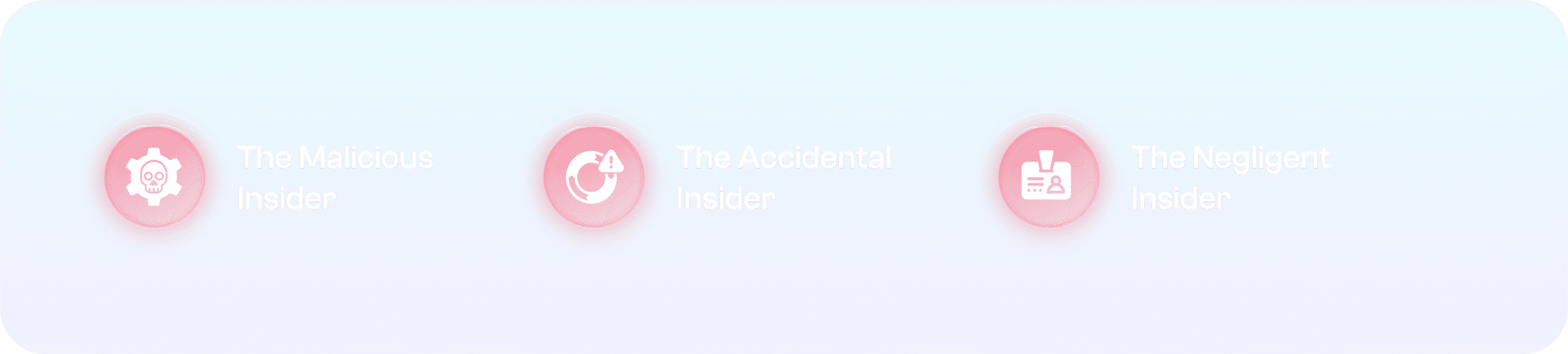
Not every insider threat looks the same. They usually fall into three buckets:
- The Malicious Insider
These are people who intend to harm you – whether that’s stealing files, messing with systems, or helping outsiders break in. Take the case of Coinbase, a cryptocurrency exchange company. They discovered a recent security breach impacting nearly 70,000 customers after hackers bribed customer support staff to gain access to sensitive data, and then demanded a ransom. Coinbase refused to pay the ransom but estimates the financial impact of the breach could be up to $400 million. That’s not just shady—that’s serious insider theft. - The Negligent Insider
These folks aren’t trying to do anything bad. But they end up causing problems anyway – like misconfiguring cloud storage, clicking phishing links, or forgetting basic security rules.An example? Disney recently fired an employee who unintentionally compromised the company’s cybersecurity in a massive breach. The employee downloaded a free AI tool that they thought was legitimate but turned out to be malware. The hacked employee then had their password credentials stolen, which was used to access the company’s internal Slack – giving attackers access to over 44 million internal messages and leaving 1.1TB of sensitive company data exposed.
- The Accidental Insider
This is the person who didn’t mean to click on a bad link… but did. Or who sent the wrong email to the wrong person. It happens more than you think. Recently, Google reported a wave of phishing emails targeting Chrome users. These emails had links loaded with sneaky malware that took advantage of a new (zero-day) vulnerability. Once clicked, it was game over. No evil intentions—just a split-second mistake that opened the door to hackers.
Why Traditional Security Tools Keep Missing the Mark
- They React Instead of Preventing
Most security systems are like fire alarms that go off after the house is already on fire. They rely on rigid rules and can’t spot strange behavior before something bad happens. So by the time your team gets an alert, it might already be too late. - Too Much Noise, Not Enough Action
Ever heard of alert fatigue? It’s real. Tools like SIEM and UEBA spit out tons of warnings, but most of them are in fact false positives, meaning harmless. When teams get buried under thousands of alerts, they start tuning them out – a phenomena known as ‘alert fatigue’ – and that’s when the real threats sneak by. - Can’t See the Whole Picture
Companies today run on a mix of SaaS apps, various clouds, personal devices, and more. But most older tools were built for office networks and can’t track what’s happening on tools like Google Drive or Slack. That’s a big blind spot. - No Time to Waste, But Manual Everything
When a threat is detected, every second counts. However, even when threats are spotted, old systems don’t act fast enough. They need human teams to do everything by hand—review alerts, pull logs, investigate, escalate. By the time action is taken, the damage may already be done. In fast-moving situations, delays can be dangerous.
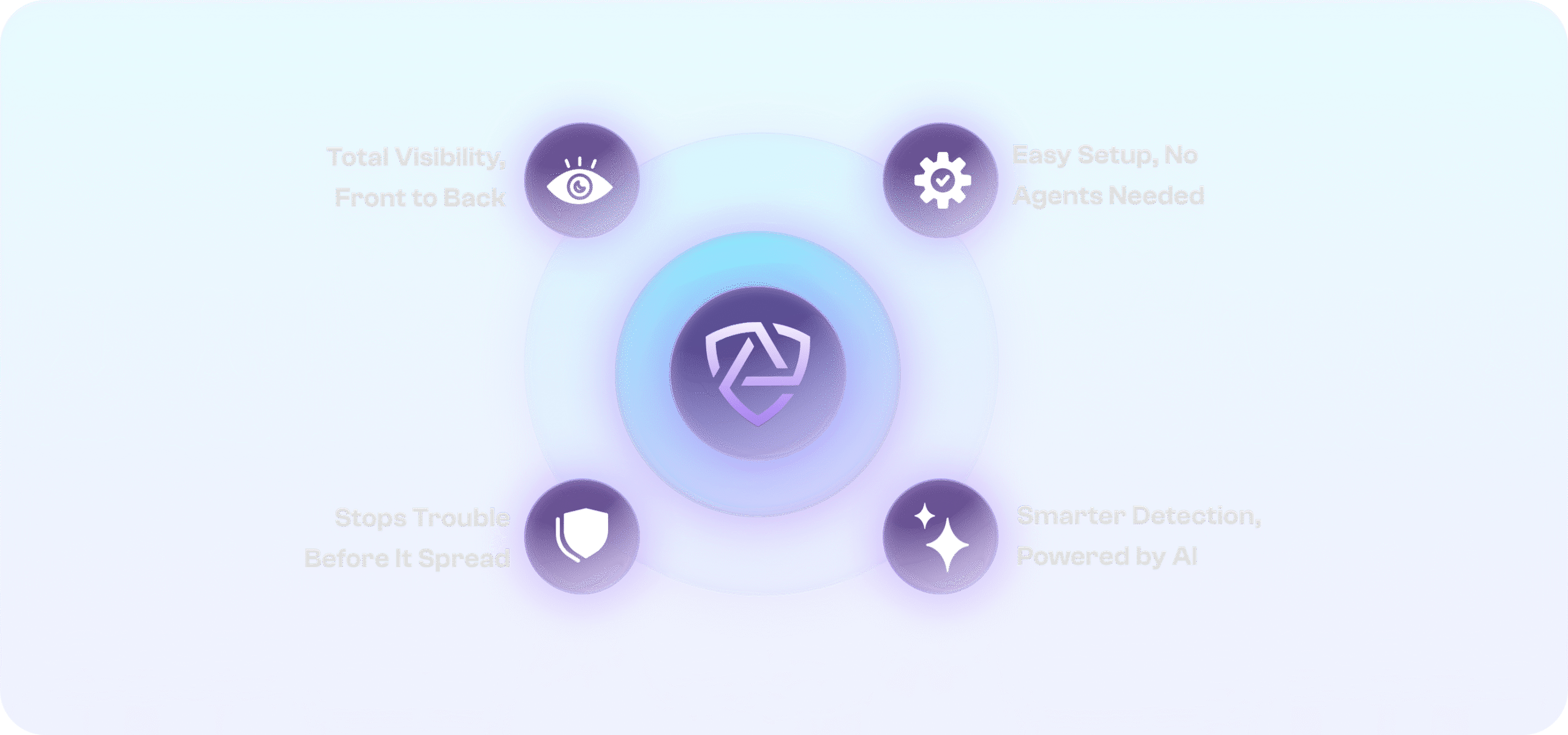
How Anzenna Handles Insider Risk the Smart Way
- Smarter Detection, Powered by AI
Anzenna uses agentic AI that looks at what people actually do across apps and devices. It finds odd behavior early—before things go wrong. Anzenna keeps your environment clear of suspicious software across desktop apps, OAuth apps, browser extensions, VSCode extensions, and developer packages. It’s like having a security guard who never sleeps and can actually think. - Easy Setup, No Agents Needed
Anzenna doesn’t need to install anything on your employees’ devices. No clunky software, no slowdowns, no complex deployment, no headaches. Just smooth protection, behind the scenes. - Stops Trouble Before It Spread
Instead of just raising a flag and waiting for someone to fix it, Anzenna jumps in automatically. It can block risky actions, stop data leaks, or flag bad behavior—all in real time. Anzenna surfaces high-fidelity risks instantly, saving your security team hundreds of hours of manual work stitching together logs from siloed systems. - Total Visibility, Front to Back
No matter if you use Google Workspace, Microsoft 365, Slack, or a mix of cloud and on-prem applications, Anzenna sees it all. That means no more blind spots, and no more guessing. Anzenna gives you deep context and cross-platform insight to prioritize security risks, all available out-of-the-box using our AI chatbot interface and reports.
Looking Ahead: The Future of Insider Risk
Companies are changing. Teams are remote, apps are in the cloud, and AI is part of the daily workflow. Old-school security can’t keep up. With Anzenna, you don’t just respond to insider threats—you prevent them. You stop problems before they start. You protect your people, your data, and your business.
Want to stay ahead of insider risk?
Let’s talk. Anzenna can help. Visit Anzenna to schedule a demo.
In May, Coinbase disclosed a massive breach, one that exposed the personal data of over 69,000 users and could cost the company up to $400 million. The attackers didn’t break through firewalls or exploit zero days. Instead they bribed overseas customer support agents at TaskUs, a third-party provider, to exfiltrate sensitive customer records.
The breach is a stark reminder. Insider risk isn’t theoretical — it’s operational, and it’s increasingly expensive.
When Access Becomes a Liability
The coinbase breach highlights how even indirect insiders like contractors and third-party agents can become a soft underbelly for sophisticated threat actors. For just $2,000, support reps handed over the keys to the kingdom. The hackers didn’t need admin rights or complex malware they just needed someone on the inside.
With stolen data in hand, the attackers launched a wide scale social engineering campaign impersonating coinbase employees and even attempted to extort the company for $20 million.
It’s the kind of breach that security leaders fear most: hard to detect, easy to replicate, and damaging far beyond the initial intrusion.
What was the Root Cause
Everyone’s focused on the $400M in damages, the ransom demands, and TaskUs fallout. But the root cause is deeper. Why did reps have open access to customer data in the first place? Where was the control layer on top of the support system? Why wasn’t rep behavior tied to support ticket volume?
From Facebook’s “God View” to the Coinbase breach, the lesson remains that your insider threat starts in the inbox, not the server room.
The Coinbase breach wasn’t an anomaly. It was a blueprint.
Why You Need Anzenna for This Moment
We saw this coming. We built for it. Insider risk isn’t a hypothetical. It’s operational. It’s human. And it’s already inside your org. Anzenna doesn’t wait for the next breach. We see it as it forms — and shut it down before it hits your bottom line. We don’t wait for logs to trickle into a SIEM. We operate in real time at the point of risk with live interventions. Fortify your forensics with our firewall for fraught human behavior.
Real-Time Risk Detection
Anzenna agentlessly integrates into your IT and support stack, including custom tools and outsourced systems. We don’t just monitor endpoints or log files. We provide a unified employee-centric view of your organization’s real-time risk posture.
Our platform identifies high-risk behaviors like:
- Abnormal access to customer data
- Repeated infections, risky installs or shadow IT use
- Social engineering patterns across support tickets
And we do it while users are still logged in.
The Old Way Looks Back. Anzenna Looks Forward.
UEBA platforms may detect such threats after they unfold, piecing together logs (if you have managed to ingest them) and anomalies (if you have written rules) long after data has left the building. But insider threads don’t wait. And neither should your defenses.
DLP solutions might find data exfiltration via certain means, but in this case the support rep was allegedly taking pictures of the customer data.
Traditional Insider Risk Solutions are Agent-based and may still not catch such sophisticated threats not to mention the significant setup and support overhead. Do outsourced support reps run IRM agents on their machines? Do traditional IRM solutions prevent the Disney type insider hack where an employee downloaded a fake AI application that stole a bunch of their sensitive data?
Anzenna is a modern insider risk solution that offers real-time risk detection through deep integrations with your IT, support, and custom systems. Whether it’s Salesforce, Zendesk, or an in-house helpdesk tool, Anzenna sees what your users are doing as they do it.
Instead of relying on passive analytics Anzenna takes action:
- Block risky applications or sessions
- Activate targeted training or warnings
- Lock access temporarily
- Disable compromised or complicit accounts
These aren’t just alerts, they’re built-in levers for automated, precision remediation with a modern AI interface.
With Anzenna, your team doesn’t just get more data. You get control.
The Real Lesson from The Coinbase Breach
The biggest takeaway from the coinbase breach isn’t about crypto tokens or even support outsourcing. It’s this: modern attacks don’t need to breach your defenses, they just need to bribe your help desk.
It’s time to move beyond policy enforcement and after-the-fact forensics. Insider risk isn’t an edge case. It’s a top threat vector and it’s one your security stack must actively address.
Anzenna delivers people-centric protection for a people-powered world because trust alone is no longer a strategy.
Don’t Wait for the Next Headline
Coinbase isn’t alone. From healthcare to fintech to manufacturing, any organization that relies on third-party support or distributed workforces is vulnerable to the same playbook.
Security tools that wait for unusual behavior to surface aren’t enough. You need a system that knows who’s doing what, where, and why at all times – before a bad actor turns routine access into a multi-million dollar crisis.
Anzenna gives you that visibility, that control, and that peace of mind.
Because the next breach won’t necessarily come from the outside – it might come from within.
What You Can Do Today to Prevent the Next Insider Breach
The Coinbase incident isn’t an edge case. It’s a preview. If your organization relies on distributed support teams, third-party access, or under-monitored internal tools — you’re in the blast radius.
Here’s what your team should do right now:
1. Audit Access to Customer Data
- Identify which users — including contractors and third-party reps — can access sensitive customer records.
- Remove standing access where it’s not essential. Use just-in-time permissions when possible.
2. Instrument Your Support Tools
- Ensure your support platform logs access to customer data, not just ticket activity.
- Track how many records each rep accesses — and whether those accesses correlate with open tickets.
3. Monitor for Behavioral Drift
- Look for patterns that indicate misuse, like reps accessing accounts they weren’t assigned or sudden spikes in data views.
- Pair behavior with context — was there a reason for the access, or was it opportunistic?
4. Test Your Visibility Stack
- Are support tools integrated into your detection and response workflows?
- If you rely on UEBA or SIEM alerts, verify that logs are ingested completely and continuously — partial visibility is a false sense of security.
5. Deploy Real-Time Insider Risk Controls
- Passive monitoring is no longer enough. Use tools like Anzenna to detect and respond to insider threats as they happen:
- Flag risky applications and sessions
- Lock accounts showing signs of compromise
- Trigger automated warnings or step-up verifications
The next breach won’t wait for your audit cycle. It will happen on a Wednesday morning with credentials that passed every check — except intent.
Anzenna stops breaches before data leaves the building.
Artificial Intelligence (AI) has introduced both new challenges and new opportunities to cyber security. On the one hand, cyber criminals leverage AI capabilities to create attacks that are more advanced and with wider scale than anything before. This is possible, since AI is a huge force multiplier for these hackers. We’re covering that aspect of cyber crime in a separate blog.
On the other hand, AI also provides a major force multiplier for cyber security defenders. Whenever defending networks, systems and data, AI enables cybersecurity vendors, and their customers, to present a good, solid security posture in the face of new AI threats. In other words, you must adopt and use AI to protect against AI risks.
Security leaders and teams need great, actionable strategies to effectively implement AI security. These strategies must include aspects such as security operations, governance, compliance, and vulnerability management. In this blog, we’ll cover these aspects and suggest some thoughts on how to best address them.
Defining AI Security
‘AI security’ involves the strategies and tactics an organization must implement to protect both its AI systems and their data, from any and all cyber threats that are out there. AI security has two aspects:
- Security for AI: Focuses on protecting each component of the AI system – data, algorithms, and applications. Protection must be comprehensive, against all threats, including data breaches, unauthorized access, insider threat, etc. The AI systems must remain confidential, reliable, and with integrity; after all, AI plays an increasingly central role in organizations’ business operations.
- AI for Security: Utilizes AI technologies to improve cybersecurity protection. AI tools automate detection and response, mitigate human errors, and enable rapid threat response. For example, machine learning algorithms examine and highlight unusual patterns in huge datasets and enable them to more effectively identify potential cyber threats, compared to conventional techniques.
Both aspects must be incorporated for an organization to achieve robust AI security. When implemented correctly, Security Operations (SecOps) and Development Operations (DevOps) teams can effectively counter cybersecurity threats and gain operational efficiency.
Understanding AI and Machine Learning
IDC predicted, in December 2023, that 85% of CIOs would change how their organizations work by 2028. They will do so to better leverage technologies like AI, machine learning, and more.
The difference between AI and machine learning is:
- Artificial Intelligence: Machines perform tasks that require human intelligence. Such tasks include learning, drawing conclusions, and solving problems.
- Machine Learning: Machines perform a specific task and provide accurate results by learning from data, identifying patterns, and doing all that without explicit programming. Machine Learning is a subset of AI.
The rapid rise of these two concepts, especially since 2023, has put a new and significant burden on cybersecurity professionals. They now must develop new expertise in AI security, something they didn’t need before. Today’s cybersecurity professionals must understand AI and machine learning, to make sure their organizations use these securely in-house, and to protect themselves from external threats leveraging these technologies.
One new challenge, for example, is how to identify and overcome vulnerabilities in AI systems. Take for instance a machine learning model that was trained on biased datasets, either intentionally or unintentionally. Then, the ML model uses the same biases to make decisions. Such biased results can have both business and ethical consequences. On the business side, the ML model may make decisions that will harm the organization’s business. On the ethical side, biased decisions lead to problematic actions in fields like law enforcement or healthcare.
Cybersecurity professionals must understand AI and ML inside and out to prevent the above. This will help them evaluate risks, prevent biases, handle AI-related security incidents, and make sure that AI and ML help their organization rather than harm it.
Addressing Workforce Shortages in Cybersecurity
The global market has a severe shortage of skilled cybersecurity professionals. We’ve known it for years, it’s nothing new. ISC2 reports on that shortage every year; they’re a non-profit organization which specializes in training and certifications for cybersecurity professionals, so they’re experts on the subject.
Back in 2022, ISC2 estimated a global shortage of 3.4 million cybersecurity professionals. The American National Institute of Standards and Technology brings many other studies from recent years about the huge shortage. Among these, NIST quotes another study, about a shortage of well over half a million cybersecurity professionals in the U.S. alone.
AI did not help to close that huge skill shortage. In fact, the exact opposite happened. Just two years later, in October 2024, ISC2 said in its annual report that the global cybersecurity workforce gap grew to nearly 4.8 million jobs! While North America is doing relatively well, and is “only” missing a little over half a million skilled cybersecurity employees, the situation is worse in Asia-Pacific, with a shortage gap of more than 3.3 million cybersecurity professionals.
This huge workforce gap is not something trivial. It affects how organizations can defend themselves. It also affects how organizations implement new technologies, such as AI, which in many organizations is mandated by the board of directors. It would not be farfetched to say that many organizations are implementing AI in a subpar way, from a security perspective.
Many organizations face a tough dilemma. On the one hand, AI provides a huge promise to their business by automating repetitive tasks. By doing so, employees can focus on things that require human attention. On the other hand, many organizations don’t have enough cybersecurity personnel to implement and use AI in a secure manner. When they do implement AI, they expose themselves to significant risks.
Cybersecurity teams themselves face a similar challenge. On the one hand, AI-based defenses enable them to do their jobs faster and more effectively. On the other hand, new AI security tools require appropriate integration, training for the security team, and possibly also adapting some processes. Implementing all of that is challenging when you’re already short-staffed.
AI also brings with it new challenges. One of them, for example, is managing risks involving non-human identities. As machine-to-machine communication rapidly increases, it’s becoming paramount to safeguard these “identities”. This is one of many places where current regulations lag behind the astronomical advancements in technology. Without a clear framework, there are numerous risks related to these non-human identities – them being hijacked, impersonated, manipulated, etc. These risks allow attackers to bypass traditional security systems unnoticed. Gartner says that by next year, i.e. 2026, about 80% of organizations will struggle to manage non-human identities, and that will create huge risks involving breaches and compliance failures.
Why is AI security important?
In a survey held in early 2024 by software company Splunk, they surveyed 1,650 cybersecurity executives across the U.S., Japan, the U.K., France, Germany, and several additional countries. In the survey, 93% of executives said their companies had already deployed generative AI for business purposes, and 91% said they’d deployed AI within their security teams. However, 34% said they lacked a complete generative AI policy.
Moreover, when asked about their top security initiatives for 2024, AI came in first with 44% of executives choosing it as their top security initiative. Cloud security came second, with 35% of executives naming it as their top priority.
When executives were asked whether AI would tip the scales in favor of defenders or adversaries, respondents were almost evenly divided – 45% predicted adversaries will benefit most, while 43% thought defenders will come out on top. This shows how even top cybersecurity leaders are divided between viewing AI as a threat or a benefit.
The conclusion: cyber threats stemming from AI security are real and are already here. These new risks put extra pressure on SecOps and DevOps teams. Organizations must proactively manage their environments, to take advantage of the opportunities that AI security presents. Else, cyber criminals will use these technologies to harm you in ways you’ve never experienced before.
I see four areas that must be prioritized for effective implementation of AI security. Of course, that’s only if you want to achieve optimal management of cyber risks (else ignore my suggestions):
- Sensitive and Regulated Data Protection
- AI Risk Mitigation
- Ethical and Regulatory Compliance
- Security Efficacy
Sensitive and Regulated Data Protection
AI systems love data. Lots of data. That’s why your AI systems attract cyber criminals, honey attracts bees. When hackers breach your AI system, it’s not just the system that’s at risk; it also breaks your customers’ trust in your company and causes serious damage to your brand. The numbers show that clearly. In 2024, the average cost of a data breach in the U.S. was nearly $9.4 million, according to IBM’s “Cost of a Data Breach Report 2024”. That number is not just a line item; it’s a business-critical event. To guard against this, you must have ultra-strong data protection. That’s non-negotiable. Encryption, Role-Based Access Control (RBAC), and rigorous security governance must be part of your foundational security.
AI Risk Mitigation
AI isn’t just another IT system – it introduces entirely new threat vectors. In my opinion, one of the most meaningful threats is model theft. It means hackers stealing your proprietary algorithms. Another new and meaningful threat is adversarial attacks, where attackers manipulate your training data, with the goal of derailing how your AI behaves, and the results it provides. These are brand new, sophisticated and high-impact threats – that your static defenses won’t be able to handle. To stay ahead of cyber criminals who have their eyes on you, your security strategies must evolve in tandem with AI innovation.
Ethical and Regulatory Compliance
AI systems often process sensitive data, like personal or regulated data. In other words, I’m referring to Personal Identifiable Information (PII), and additional types of sensitive data you don’t want leaked. GDPR, CCPA and other regulatory frameworks are not just guidelines; they’re legal guardrails and must be taken with outmost seriousness. It’s great if your compliance is such that you avoid penalties; however, true strong compliance is much more than that – it’s about maintaining transparency on how your AI decisions are made, so that you can avoid risks like bias. Else, biased models can cause real harm in areas like hiring, healthcare, and law enforcement.
Security Efficacy
As I mentioned earlier, AI is both a risk factor but also a powerful partner. Machine learning systems detect anomalies in real-time and help security teams to identify and respond to threats in a faster way. Since today’s threat landscape evolves faster than ever, with new attack techniques constantly developing, you can use any partner you can get to fight against bad actors. The speed and precision offered by AI is an absolute game-changer, in that respect.
AI Security Risks
AI brings incredible potential, but it also opens the door to new risks that traditional security tools weren’t built to handle.
Data Poisoning and Adversarial Examples
Attackers can corrupt training datasets (data poisoning) or craft malicious inputs (adversarial examples) to throw off AI results. The consequences? Misguided decisions in highly-regulated sectors like healthcare, finance or public safety—and that’s a risk no one can afford.
Model Theft
When threat actors get access to your AI models, they’re not just stealing code—they’re stealing intellectual property. Worse, stolen models can be used to power everything from deepfakes to targeted cyberattacks.
Prompt Injection Attacks
Generative AI systems are especially vulnerable to prompt injection attacks. These manipulate model inputs to produce misleading or dangerous outputs. The more organizations rely on GenAI, the more they’ll need to secure it.
AI Supply Chain Risks
AI systems don’t operate in a vacuum. They depend on APIs, third-party models, open-source components—all potential attack vectors. Without strict supply chain controls, organizations risk importing vulnerabilities from third-party components and services straight into their systems.
Mitigating Risk Using AI Security Frameworks
Managing AI security risks starts with robust data governance. That means classifying, securing, and monitoring data throughout its lifecycle. As Gen-AI tools become more mainstream, governance gaps – like oversharing sensitive data – can become ticking time bombs.
RBAC is crucial here. Access to AI systems and datasets must be limited to those who truly need it. You should bring together teams responsible for identity, data security, compliance, and digital workplace tools – them working together will help close governance gaps and create a more unified front.
The sheer scale of the challenge is huge, and it keeps growing at a fast pace. Large enterprises face billions of cyber events each day. With some teams receiving 10,000 alerts daily, it’s clear we can’t rely on humans alone. That’s where smarter AI systems come in—to handle volume, detect true threats, and cut through the noise.
AI Security Strategies That Work
Want to make a real dent in security threats? AI and automation can resolve up to 85% of cyber alerts, according to IBM. Beyond efficiency, AI and automation also help compensate for the cybersecurity talent gap.
Let’s break down how to secure AI across three key areas:
Data Security
- Encrypt sensitive data, both at rest and when in transit.
- Enforce RBAC so only the right people have access to critical information.
- Continuously monitor for anomalies that may be possible threats.
Model Security
- Validate sources to ensure model inputs and updates are trusted.
- Secure APIs and plugins to prevent exploitation.
- Harden models to protect them against manipulation or performance degradation.
Usage Security
- Implement ethical guardrails to prevent any misuse of AI-generated content.
- Monitor in real-time to detect prompt injections, data leakage, or unexpected behaviors.
- Use anomaly detection to flag anything that seems “off” within AI environments.
Emerging AI Security Tools to Know
As both the threat landscape and AI technologies continuously evolve, so do the tools we need to fight back:
- Machine Learning Detection and Response (MLDR): These tools monitor AI systems at every stage of development, and flag security risks they identify.
- Security Orchestration, Automation, and Response (SOAR): These platforms automate threat detection and response and enable cybersecurity teams to handle incidents in a much faster and more efficient way.
No surprise, then, that a Salesforce survey, held in 2024 among hundreds of leaders in large Australian enterprises, found that 43% of executives saw increasing productivity as a main reason to adopt AI in security. It’s not about replacing humans – it’s about empowering them to do more, better.
Four Best Practices for AI Security
To stay ahead, organizations should anchor their AI security around four proven principles:
- Enforce Governance Frameworks
Work with compliance and GRC teams to ensure AI systems align with ethical standards, minimize bias, and meet legal requirements like GDPR.
- Adopt the CIA Triad
Keep Confidentiality, Integrity, and Availability front and center in all security decisions – it’s foundational for user trust and operational stability.
- Secure the AI Lifecycle
From training to deployment, embed security into every step. DevOps and SecOps teams should collaborate, protect the Continuous Integration / Continuous Delivery (CI/CD) pipelines, and enable continuous monitoring.
- Promote Explainability and Trust
Transparent, explainable AI models build trust, streamline debugging, and make it easier to prove compliance. In short, clarity leads to credibility.
The Road Ahead: Balancing Innovation and Security
In this blog, we covered two aspects of AI security. The first was how to protect AI systems from vulnerabilities. The second was how to use AI to improve your organization’s cybersecurity posture.
But AI security isn’t just about defense. It’s also about enabling safe, scalable innovation for your organization. Yes, we need to secure data, models, and systems – but we also need frameworks that evolve alongside technology.
The goal isn’t to slow down AI adoption – heck no! The main message I wanted to convey in this blog is – let’s do it the right way.
By building security into the core of your AI strategies, your business can unlock massive potential – boosting productivity, streamlining decisions, and protecting what matters most in the process.
FAQ
What is AI security?
AI security includes two parts. The first is protecting AI systems, including models, applications and data, from online attacks. The second part is using AI to strengthen the organization’s overall cybersecurity defenses.
How does AI improve cybersecurity?
AI improves cybersecurity by automating detection and response systems. This automation lowers the possibility of human error and enables organizations to react much quicker to possible threats.
What are the main risks in AI security?
The main risks in AI security include data poisoning, adversarial attacks, model theft, and weaknesses in the AI supply chain. An organization that implements AI systems must address all these issues and implement proper safeguards.
How has Generative AI affected security?
AI has fundamentally changed the game with everything regarding security. The risks have increased significantly, and additional risks have been added such as data misuse, misleading outputs, and theft of intellectual property. All of these are creating the need for organizations to have stronger ethical and technical guardrails.
What’s the best way for us to prepare?
The best way to prepare is to take action early. Start with proactively implementing AI-specific security protocols, cross-functional governance, and continuous training for all employees. The sooner you act, the safer your organization will be.
Generative AI is a field within artificial intelligence. GenAI digests enormous amounts of data, and later creates new content, such as text, images, videos or music, based on what it learned from the data it digested. While the roots of generative AI go back to the 1950s and 1960s, it’s only in the last decade that GenAI leaped forward and gained wide adoption. The most famous leap, and public recognition, occurred in late 2022, when OpenAI launched its ChatGPT. This launch has shaken the business world in ways we don’t yet fully understand.
One result of the ChatGPT launch – it fundamentally affected how organizations look at and manage their digital security risks. Traditional AI “just” looks at data and predicts outcomes. It has been used in many aspects over the years, from medical research to weather predictions to fraud detection and prevention.
Generative AI is different. It creates new content that identifies repetitive patterns. This capability makes Gen AI useful for cybersecurity, as it helps identify threats, detect anomalies, and triage incident response.
On the plus side, gen-ai helps cybersecurity detect various threats, and it does so very fast. On the con side, this “game” is played by both sides, and bad actors also use Gen AI. Cybercriminals are using this technology to create complex attacks, with the goal of these attacks avoiding detection by both human and cyber systems. The FBI recently warned that cybercriminals leverage gen-AI to initiate unprecedented amounts of fraud, where Gen AI is used to create advanced phishing and social engineering attacks.
But external bad actors are only part of the picture. Gen AI also increases the risk of insider threats, whether these actions are intentional or unintentional. In short, Gen AI capabilities serve both cybercriminals and cybersecurity defenders, which means the defenders must utilize the technology and always be at least one step ahead of bad actors. Cybersecurity defense, that is not based on advanced gen-AI, is worthless today.
Gen AI Role in Cybersecurity
Generative AI enables cybersecurity vendors and customers to strengthen both resilience and incident response. It enables us to modernize the traditional Security Operations Center (SOC) and provide security teams with advanced tools for threat management and risk evaluation. The combination of human analysts with AI detection technologies offers capabilities that were not available until now.
Security teams using gen-AI can find system vulnerabilities and react to threats in a matter of minutes. Using advanced algorithms, gen-AI can tap into previously disparate sets of data, to correlate analysis. By doing so, it can alert teams on out-of-the-norm activity in the environment, such as device and application threats, cloud data exfiltration, and identity compromises. These alerts can then trigger human investigations and initiate incident response. Gen AI simplifies previously manual tasks that typically increased risks and led to preventable breaches.
There are four primary areas where gen-AI is making a significant impact in the SOC: threat detection and response, email filtering and phishing prevention, automated incident reporting, and security orchestration and workflow automation.
- Threat Detection and Response: Gen AI increases capabilities to detect abnormal variations in network traffic through advanced anomaly detection techniques. With rapid analysis of logs, internet traffic, and packet captures, gen-AI technology can flag deviations that may indicate potential breaches, thus enabling fast human investigation. Traditional systems are bogged down by false positives and delayed responses. With gen-AI, SOC teams enjoy significantly reduced alert fatigue and measurably improved response times to threats across on-premises, hybrid, and cloud environments.
Gen AI enables security teams to concentrate on actual threats, rather than chase false positives. The result is faster vulnerability scanning and simpler patch management. Gen AI efficiently prevents critical risks like phishing, data exfiltration, insider threat, and SaaS vulnerabilities. It also supports advanced capabilities like malware simulation, digital forensics, and incident response. - Email Filtering and Phishing Prevention: Phishing attacks have become more sophisticated and harder to detect. Gen AI significantly strengthens the organization’s ability to defend against that threat. It does so by analyzing email characteristics, to identify fraudulent communications. Gen-AI investigates linguistic patterns, context, and also sender behaviors, and can thus detect signs of phishing, that traditional methods may miss.
Once organizations deploy AI-driven email filters, these will automatically block or flag any suspicious messages for further inspection. By that, gen-AI significantly reduces the risk of a successful phishing attack on the organization. This approach reduces the load from the SOC team. It also reduces the risk of employees falling victim to social engineering attacks that are used by cyber criminals.
- Automated Incident Reporting:
security teams typically deal with excessive amounts of data, from multiple sources. This makes it difficult to create cohesive reports on security incidents. Gen-AI helps organizations to automate the creation of incident reports, based on real-time data analysis that is done by the gen-AI system.
Unlike humans, or non-AI systems, gen-AI systems can combine data from various sources and provide useful insights to security professionals. This automation allows SOC teams to focus on critical prevention tasks and leave the administrative work to gen-AI. This approach improves the overall efficacy of the incident response process.
- Security Orchestration and Workflow Automation:
Cybersecurity teams perform many daily, routine tasks, like monitoring network traffic, scanning for vulnerabilities, and performing malware assessments.
Gen AI automates these repetitive, manual tasks. It also handles them more efficiently, compared to human employees. This enables the organization to free SOC employees, so they focus on challenges that require human intervention. Dividing the work between Gen AI and human employees enables organizations to prevent burnout of their SOC team and get better overall security results.
How Cyber Criminals Use Gen AI
Criminals increasingly use Gen AI to generate more sophisticated attacks and larger scope of financial fraud. Malicious actors use these advanced technologies to create better and more believable content that would manipulate individuals and bypass traditional security systems.
The following are samples for Techniques, Tactics, and Procedures (TTPs) that are used for cyberattacks:
- SMS and Phishing Campaigns: Criminals use AI to create convincing SMS messages and emails. By that, they make social engineering attacks like spear phishing and romance scams appear genuine to their designated targets, and hence more effective for scammers. AI-generated communications can be personalized, to increase the likelihood of victims falling prey to these scams.
- Fake Social Media Profiles: Gen AI makes it easy for hackers to create fictitious, authentic-looking social media accounts. Such fake profiles are used in scams called ‘confidence fraud’, where scammers trick victims into trusting them, often by portraying themselves as a loved one, friend, or expressing romantic interest.
- Fake Identification: Criminals use AI to create fake profile photos, or even full identification documents. Then, they use these to give credibility to their fake personas. This tactic is used in identity theft and impersonation, for example.
- Voice Cloning: Gen AI can generate audio clips that impersonate voices of trusted individuals. You probably heard clips where famous politicians or celebrities are presumably saying things they never did. In a similar way, hackers create “vishing” campaigns (short for “voice phishing”). This phishing attack uses phone calls to trick individuals into revealing sensitive information. Scammers generate voices that their victims know and would trust, like their boss or a business partner. The goal of such campaigns is typically to manipulate victims into authorizing financial transactions or providing sensitive information.
- AI-Generated Videos and Deepfakes: Like with the previous bullet, you probably saw multiple fake videos of politicians or celebrities. These AI-generated videos are called ‘deepfakes’ and can look very realistic. Their goal is to trick victims into believing that they are dealing with legitimate authorities, or with a business representative, when it comes to video calls. For example, in today’s competitive recruiting market, there have been reports about companies that received an influx of fake applicants, especially for IT roles, where the applicants used deepfake videos for video interviews (Zoom, for example). Once they pass the interview process and get hired – and there are multiple reports of such cases discovered retroactively – the scammers can get access into highly sensitive IT systems the organization has.
- Insider Threats: Attacks by external scammers are dangerous, but Gen AI can also be misused by insiders. Real employees may attempt malicious activities, such as creating false data, stealing data, or attempting financial fraud. The common denominator for all these is that the security breach attempts originate from within the organization’s network, not from the outside. But even loyal employees may be tricked into unintentional threat actors by cyber criminals. The latter have a large arsenal of TTPs that they can use, including trying to get employees to click on a Gen AI phishing email, or to be compromised by vishing or deepfakes. The result of these activities, whether intended by employees or being tricked by malicious actors, can lead to breaches of sensitive data or fraudulent financial transactions.
A study on The State of Phishing 2024”, held by SlashNext, shows a dramatic increase in malicious emails activity. Since the launch of ChatGPT in late 2022, the study states a staggering surge of 4,151% in malicious emails. The same study showed that in the middle of 2024, there was an 856% increase in malicious emails in the previous 12 months. These numbers illustrate how common AI-generated attacks have become. As Gen AI technology continuously evolves, security teams must prioritize using Gen AI security defenses, to protect sensitive information and financial assets.
The Importance of Security Teams Using Gen AI
AI-powered attacks are becoming both more complex and widespread. Threat actors leverage AI to develop sophisticated attacks. As a countermeasure, security teams must also adopt gen-AI capabilities to maintain an advantage against threat actors. It’s becoming increasingly hard, even impossible, for security teams to protect against an ever-growing number of new security threats without using gen-AI themselves.
Organizations must adopt AI-enhanced security tools that help their security teams fight against AI-based attacks. Cybersecurity teams in the future, and some already do that at present, include both human analysts and Gen AI security technologies. Such AI-based security tools allow the organization to scale safely, while also reducing manual efforts and human errors.
The Gen AI Advantage for DevSecOps
Generative AI can transform SOC and engineering teams by turning DevSecops from reactive to proactive. CISOs and GRC leaders must evaluate their governance and security frameworks and increase the adoption of DevSecOps that leverages Gen AI. Security leaders must also verify that new technologies comply with regulations and follow best practices regarding the usage of gen-AI.
Implementing Generative AI in the SOC
It is guaranteed that threat actors will continue to take advantage of AI and come up with increasingly sophisticated cyber threats. In response, organizations must integrate gen-AI into their security systems. This requires a balanced approach that prioritizes collaboration between technology and human expertise. It is crucial to select the right gen-AI provider, so that security teams can be effective and resilient when responding to new threats. Gen-AI enables the SOC to have improved visibility and response times, By leveraging fast technology and improving visibility and response times, thus strengthening the organization’s defenses and make it more secure against criminals who also use Gen AI.
FAQ
What Is Generative AI?
Generative AI is a subset of artificial intelligence. It analyzes vast amounts of content and data, and “learns” from these. Then, when a user submits a query, the gen-AI system can generate new content, based on what it previously learned. The new content can be text, charts, images, audio, video, code, and more.
What’s the difference between gen-AI and traditional AI?
Traditional AI systems primarily analyze historical data, with the goal of forecasting a future outcome. This is used for weather forecasting, financial modeling, voting patterns, and more. Generative AI, on the other hand, focuses on creating new content, based on patterns it learned from existing data it previously analyzed.
How can Gen AI improve threat detection?
Gen AI-based threat detection analyzes huge datasets and looks for anomalies. The Gen AI system knows what normal operations look like, and these make the vast majority of operations in the datasets it reviews. Once the Gen AI finds an anomaly, it flags it for further inspection. The trick is that gen-AI does all that in incredible speed, literally in real-time, which enables organizations to quickly respond to incidents, and hence reduce the chance of a security breach.
Which attacks can Gen AI help prevent?
Gen AI is effective against attacks that require analyzing huge amounts of data, or traffic patterns. Then, the AI system flags out anomalies, which are suspicious activities. These attacks include data exfiltration, phishing, malware, and automated social engineering.
Are there any ethical considerations for using Gen AI in cybersecurity?
Yes, there are ethical considerations to investigate when implementing a Gen AI system for cybersecurity. These include data privacy, algorithmic bias, and also the potential for misuse by adversaries. Organizations should establish clear policies and governance frameworks, to make sure they use Gen AI in a responsible manner, both respecting ethical guidelines and complying with regulations.
Will Gen AI change cybersecurity? How?
This is not a futuristic question, but something that’s already happening at present. Gen AI is already changing cybersecurity. Threat actors leverage Gen AI to launch increasingly sophisticated and larger attacks. In response, organizations must also invest in AI-powered cybersecurity systems, to give their security teams a fighting chance against cyber criminals. Gen AI cybersecurity tools anticipate emerging threats, while making the job of human analysts much easier – all with the goal of improving the organization’s overall security posture and prevent breaches.
Cybersecurity: A Portrait
(And why you’re standing too close)
You lock the doors and they come down the vents. You patch the system and they phish your senior copywriter. You upgrade your firewall and someone shares a sensitive link in Slack.
Cybersecurity plays out across cloud platforms, remote teams, legacy infrastructure, and a revolving door of unknown adversaries. It’s not only about protecting your data — it’s about managing risk, optimizing operations, reinforcing resilience, and defending trust and as much about strategy as it is software. And it never, ever stands still.
If you feel like you’re trying to solve each alert, incident, and each new compliance request — take a step back. Cybersecurity today isn’t one problem — it’s a series of perpetually shifting jigsaw puzzles.
Pick up the pieces you’re missing.
Seven Cybersecurity Pillars
How not to get owned in 2025.
Tenets that should live rent-free in your head.
01
Network Security
Firewalls, DLPs, NGFW, IPS, NAC. Attackers don’t give a **** about your acronyms. These cybersecurity solutions are meant to prevent unauthorized access, filter traffic, and enforce web policies but threats slip in looking like legit users. That’s where deep visibility matters – without behavioral insights and anomaly detection, you’re only scanning the surface.
02
Cloud Security
With more data in the cloud than ever before, cloud security has become one of the most critical types of cyber security. Misconfigurations, identity gaps, and shadow IT create open doors for cybersecurity threats. You need third-party solutions that actually secure data in motion, at rest, and in use.
03
Endpoint Security
Every laptop, tablet, and rogue USB drive is a front line that needs back-up when your workforce operates wherever there’s access to a hotspot and HubSpot. Proper endpoint security begins with real-time monitoring, response capabilities, and building resilience from the device up.
04
Mobile Security
Phones are miniature platinum mines of corporate access — portable, personal, and perilous for an attack surface fitting in your pocket with a panoramic blast radius spanning your whole organization. Cybersecurity requirements for mobile environments include MDM, threat detection, anti-phishing, and protection from IM-based attacks.
05
IoT Security
The rise of smart devices introduces new types of cybersecurity threats — especially when they connect to your network without your knowing. Think HVACs, cameras, even lightbulbs. They don’t come with strong security defaults, making proactive IoT monitoring critical.
06
Application Security
Web and mobile apps are a favorite target for hackers. OWASP Top 10 threats like injection attacks, cross-site scripting, and broken authentication are common cyber security threats. Application security needs to scale with DevOps — meaning automated testing, runtime protection, and API visibility.
07
Zero Trust
Never trust, always verify. Every login, request, and data access is suspect until proven safe. It’s not post-modern paranoia. It’s modern architecture. And it’s the only way to meaningfully secure remote, hybrid, and cloud-native environments.
Threats Have Evolved (Have You?)
Gen I-V Malware: From floppy-disk curiosities to enterprise-scale ransomware rings, malware is now swifter, stealthier, and sharper than ever. AI-powered malware isn’t a Black Mirror episode – it’s today.
Phishing: It’s no longer typo-addled Nigerian princes. It’s near-perfect fakes with your CEO’s face and your brand’s favicon. Business Email Compromise (BEC) is big business built on little blunders.
Supply Chain Attacks: Your software is only as secure as the weakest vendor with access. Think SolarWinds, Kaseya, and every single SaaS tool that integrates with everything else. Zero Trust isn’t optional here.
Insider Risk: Not every threat actor plays Fortnite in his mom’s basement. Some wear company badges. Some accidentally send files to the worst person imaginable. Some leave sensitive IP behind because no one revoked access. Risk isn’t always a red alert. Sometimes it’s a calendar invite for a zero-sum game.
Ransomware & RaaS
Ransomware-as-a-Service has lowered the barrier to entry for cybercrime. Now, even amateurs can deploy sophisticated payloads. It’s not just encryption anymore — it’s data theft, public shaming, and operational blackmail.
Brand Impersonation
Bad actors spoof your domain, site, and look-and-feel, duping your customers and ruining your reputation. This isn’t only a phishing problem. It’s a trust crisis.
Less Tools. More Tactics.
Everyone has a firewall, endpoint tool, SIEM, DLP, CASB, and AI that scolds the interns. But none of it helps if those tools don’t talk to each other — or worse, drown your team with noise while the real risks go undetected.
Cybersecurity stacks are often cobbled together with a tool for every threat vector, a dashboard for every team, and a seemingly neverending log stream. But what happens when those tools don’t communicate or worse –– contradict each other?
Security teams end up burning cycles chasing false positives and sifting through siloed systems. Detection doesn’t equal protection. Especially when alerts arrive in bulk with no context, prioritization, or clear path to remediation.
Visibility isn’t about volume — it’s about correlation. And correlation requires integration. Without that, every tool is just another torrential scream in the void adding to the cacophony of security fatigue: Analysts overwhelmed with dashboards. Engineers frustrated by gaps. Executives unsure what’s actually working.
All equating in delayed responses, missed threats, and an eroding sense of trust in the security apparatus itself.
Consolidation matters. Clarity matters more.
Where Anzenna Fits In
We made Anzenna Detect for this world — not the 2005 threat model your legacy tools still cling to.
Experience:
- Total transparency into user behavior across apps, channels, and devices
- Contextual AI-powered risk scoring – not mindless alerting
- Sound policy enforcement without disrupting your people
- A real chance to spot insider risk and exfiltration before it becomes an incident
Cybersecurity FAQ
What is cybersecurity? Cybersecurity is the practice of protecting systems, networks, and data from unauthorized access, damage, or disruption. It covers everything from firewalls to culture.
Why is cybersecurity more complicated now? The rise of cloud, remote work, BYOD, AI tools, and increasingly sophisticated threats means organizations face more attack surfaces than ever before.
What’s the difference between a breach and an exfiltration? A breach means someone got in. Exfiltration means they took something out. One is a nightmare. The other is worse.
Do I really need Zero Trust? If your users, data, and apps are everywhere, then yes. Zero Trust helps ensure every access request is checked, regardless of location or device.
Can AI actually help in cybersecurity? Absolutely. AI can spot patterns, flag anomalies, and surface real threats in oceans of noise. The trick is using it intelligently — like Anzenna Detect does.
Is employee training enough? It’s necessary but not sufficient. Combine awareness with monitoring, smart tooling, and a culture of accountability.
What makes Anzenna Detect different? It connects the dots between user behavior, context, and risk — across apps and platforms. It doesn’t just tell you something happened. It shows you what to do next.
The Risk Is Real. The Response Is Anzenna.
You can’t afford to rely on a fortress mentality when the battlefield is everywhere. The definition of cybersecurity now includes cultural resilience, rapid response, and proactive visibility.
It also requires a new mindset: that cyber defense isn’t an IT issue – it’s a business priority. The threats don’t just impact data – they touch revenue, brand reputation, operational continuity, and customer trust.
Modern cybersecurity must operate on two fronts: strategic and tactical. Strategically, organizations need to define what assets matter most, who can access them, and how that access is monitored and revoked. Tactically, they must react to incidents in real-time, shut down active threats, and continuously learn from past mistakes.
That means your security posture can’t be static. It must evolve as your environment, users, and threatscape changes. And it has to do it without exhausting your teams or overwhelming your systems.
With solutions like Anzenna Detect, businesses can build a unified security experience that empowers teams instead of burdening them. You don’t need to be perfect – you need to be ready. Ready to detect, respond, and adapt. That’s what separates companies that suffer breaches from those that prevent them.
Build a foundation that helps you see what’s coming, understand what’s happening, and respond like it actually matters.
Take that step back.
Now surge your cybersecurity forward with Anzenna.
When most people think about cybersecurity they picture hackers breaking into networks from some far-off location. But what if the real risk is much closer to home? In fact, some of the biggest security threats companies face today come from inside. Not necessarily from people with bad intentions, but often from simple mistakes, negligence, or small oversights that spiral into big problems.
This is what we call insider risk. And if you don’t have a clear plan for managing it, you could be leaving your organization wide open.
Let’s take a closer look at what insider risk actually means and how it’s different from insider threats and what you can do to stay protected.
What Is Insider Risk?
Insider risk happens when people inside your organization – employees, contractors, vendors, or partners – accidentally (or intentionally) create a situation where sensitive data systems or operations are exposed to harm.
The key thing to understand is that insider risk doesn’t always mean someone’s being malicious. More often than not, it’s about carelessness. Someone might send a confidential document to the wrong email address. Or they might upload sensitive customer information to their personal cloud storage without realizing the risks.
It’s not about “bad people” – it’s about good people making bad decisions.
Insider Risk vs. Insider Threat
You might hear insider risk and insider threat used interchangeably, but they are not quite the same.
- Insider risk: the potential for something bad to happen because of someone’s actions or mistakes.
- Insider threat: when someone or something intentionally acts to cause harm.
Think of it like this: forgetting to lock your front door is insider risk. But someone walking through that door and stealing your stuff is insider threat.
Both matter. But insider risk is more broad and often harder to detect because it doesn’t necessarily look like an attack.
How Insider Risks Slip Through the Cracks
You might have all the right tools—firewalls, password policies, compliance training—and you still find yourself facing an insider incident. Why? Because insider risks don’t always set off alarms.
Take an employee working late. They transfer customer records to a personal email so they can finish up at home. Innocent intention, dangerous move. Or a contractor who’s given broad access “just in case” — and ends up leaking proprietary data. These things happen when processes aren’t airtight and assumptions are made.
And the problem isn’t always tech related. Sometimes it’s cultural. Maybe people feel too rushed to double-check details. Maybe no one wants to speak up when something seems off. Or maybe security feels like a check-the-box thing instead of a shared responsibility. The key is staying humble. Even well-meaning teams overlook things. Building a culture that expects the unexpected and is prepared to respond makes all the difference.
Why Managing Insider Risk Matters
Here’s the thing: insider risks are everywhere. And the consequences of ignoring them can be devastating.
- Financial losses: data breaches caused by insiders can cost millions in fines, legal fees and lost business.
- Regulatory trouble: industries like healthcare, finance and tech are under strict compliance laws. Drop the ball and you face serious penalties.
- Reputation damage: Losing customer trust is sometimes even harder to recover from than losing money.
- Business disruption: Data leaks, IP theft, and system sabotage can bring operations to a halt.
Managing insider risk isn’t just nice to have. It’s critical for survival.
The Cost of Getting It Wrong
Insider risks can feel small at first. A misplaced file. An account left active after someone quits. A quick download of sensitive data, just in case. But these small moments can snowball into major problems, and when they do, the cost hits fast and hard.
There’s the immediate cleanup: investigating what happened, who was affected, and how far the damage spread. That alone can soak up weeks of time and resources. There are even legal implications, especially if customer data or trade secrets are involved.You may have to notify stakeholders, deal with regulatory blowback, or even face lawsuits.
But even when the issue stays in-house, the loss of trust internally is real. Teams get more cautious, workflow slows down, and morale takes a hit. Add in the cost of rolling out stricter controls after the fact, and the disruption to day-to-day work, and suddenly the harmless mistake doesn’t feel so harmless.
The truth is, most insider risks come after the incident. That’s why catching them before they escalate isn’t just smart security – it’s smart business.
Why Insider Risk Is a Leadership Issue
Insider risk isn’t only about data – it’s a blind spot leadership can spotlight.
That’s because the way people handle data, follow policies, and respond to risk is shaped by what they see from the top. If leaders take security seriously, their teams are far more likely to do the same. If leadership waves off security practices as red tape, those habits trickle down.
Managing insider risks means creating a culture where security isn’t an afterthought. That starts with leaders who make thoughtful access decisions, ask questions about how data is handled, treat mistakes as learning moments, and do not play blame games. It also means making sure security and productivity aren’t seen as opposites. Good leadership builds systems where people can do their jobs efficiently, while still protecting what matters.
The goal isn’t to make people paranoid. It’s to make security part of how the business runs, everyday. That only works when it’s coming from the top.
How to Manage Insider Risk Effectively
Insider risk management is not just about data access.
-
Identify Your Critical Data
Know what is truly important – intellectual property, customer data, financial information. Focus your protection efforts here.
-
Implement least privilege access
Give employees and contractors only the access they need – nothing more. Review access permissions regularly.
-
Monitor user activity
Use tools to track abnormal behavior like accessing large amounts of data late at night.
-
Provide ongoing training
Make cyber security awareness part of your culture. Train employees to recognize phishing scams, safe data practices, and the why behind security policies.
-
Create clear policies and enforce them
Document your expectations around data. Use device management and information sharing. Then back them up with consequences for violations.
-
Prepare for incidents
Have a response plan ready when something goes wrong. The faster you can react, the less damage done.
Pro Tips for Building a Resilient Culture
Managing insider risk isn’t just about technology. It’s about people.
- Promote trust, not fear. Employees should feel comfortable reporting mistakes or suspicious activity without fear of retaliation.
- Reward good behavior. Recognize teams or individuals who follow security best practices.
- Communicate constantly. Make cybersecurity part of everyday conversations, not just something you talk about once a year during training.
Insider Risk Is Everyone’s Job
It’s easy to assume that insider risk is the responsibility of IT or security teams. But in reality, it shows up in everyday behavior, across every department, role, and level of access. That’s why managing it requires a shared sense of ownership.
Insider incidents don’t ignite with insidious intentions. They start with little moments: a rushed decision and overlooked detail or shortcut that seemed harmless. When everybody on the team understands that their actions affect the organization, security risk becomes easier to spot and stop.
To build that kind of awareness focus on:
- Encouraging questions – normalize asking things, e.g., Is it okay to send this externally?
- Normalizing check-ins – remind people that it’s better to double check than to assume
- Rewarding caution – recognize people who pause and do the right thing even when it takes extra time.
- Making reporting safe – ensure that if someone sees something off, they know they won’t be punished for speaking up.
Security isn’t a separate function. It’s part of how work gets done. The more every employee sees their role in protecting data, the less likely it is that the small risks turn into serious problems.
FAQ: Insider Risk and Insider Threats
What exactly is insider risk anyway?
Insider risk is all about the possibility that someone inside your organization could accidentally or intentionally put your sensitive data at risk. It’s often about good people making bad decisions.
Wait, how’s that different from insider threat?
Risk is potential; threat is action. Risk is leaving your front door unlocked. Threat is someone stealing your stuff.
What are some real world examples of insider risk?
Sending sensitive files to the wrong person. Saving company data to a personal device. Or reusing weak passwords that have been stolen.
How do companies spot insider risks before they turn into disasters?
It’s a mix of smart technology, training, and paying attention. Monitoring tools help, but teaching employees to recognize red flags is just as important.
Why is insider risk? Such a big deal right now?
Because work is more decentralized than ever. Remote employees, cloud apps, and constant data sharing make it harder to control who touches what — and easier for mistakes to happen.
Bringing It All Together
Insider risk management isn’t about disrupting your people. It’s about creating an environment where both your team and data stay protected.
By putting smart systems, policies, and culture in place, you’re not just reducing risk — you’re setting your business up for more resilience in an unpredictable world.
Remember: the threats outside your walls are out of your control. But the ones inside?
Those are the ones you can actually do something about.
When they go to work on any given Tuesday morning, bank employees are not usually expecting a robbery. But, just in case, banks are prepared with multiple layers of security.
Their security would be incomplete if they just focused on keeping bad guys out; they also need systems in place to make it harder for anyone (even their own employees!) to steal the money.
Cybersecurity is not all that different. If a data breach is a bank robbery where intruders take control of the bank lobby, data exfiltration is when they access the vault to take your Cloud jewels. Thankfully, with the right tools and systems in place, data exfiltration is preventable and your data can remain safely locked away from the morally bankrupt among us.
What is Data Exfiltration?
When cybercriminals successfully infiltrate – or gain unauthorized access to your sensitive data – they have breached the network.
Data exfiltration is when an unauthorized person steals data from the original, compromised device and puts it onto the attacker’s device. This form of theft may happen by removing, moving, or copying data from a computer, mobile device, server, IoT device, cloud storage, printer or scanner, or other data-storing environment.
Data Exfiltration Meaning
The simplest way to understand data exfiltration is to look at the definition of the term “exfiltrate,” including the way it is used in other settings. To exfiltrate is to remove, and it is commonly used in a military context to discuss a secret or clandestine removal of troops or spies.
If you visualize spies fleeing into the night on a stolen speedboat, carrying top secret information with them, then you’re thinking of a less-action packed instance of what would happen if your data were exfiltrated. An adversary stealthily steals information they are not intended to have and then uses it for ill-gotten gain.
Data Exfiltration Techniques
There are several common ways bad actors attempt to exfiltrate data:
- Social engineering, including phishing
You are probably already familiar with phishing and social engineering. In these attacks, a bad actor is a wolf in sheep’s clothing and poses as a safe, trusted party. Then, they ask for login credentials or other information that will allow them easy access to sensitive information.
In an exfiltration, a bad actor would use their unauthorized access to copy or move sensitive data to servers or device storage they control.
- Malware
Potentially as a result of social engineering, or possibly through a more direct cyberattack, a bad actor will attach unauthorized and compromised software that controls or gives them access to your data. It may go undetected for some time, leading to malware scanning for and extracting desired information that then ends up in the hands of the bad actor.
- Exploiting vulnerabilities
If members of your organization use weak passwords (we’re looking at you, “password123”), don’t update their hardware or software with appropriate patches, or misconfigure either cloud storage or servers, it can act as the equivalent of leaving the front door unlocked.
A bad actor utilizes one of these open doors to access sensitive information, or possibly to plant malware, that will then offer the opportunity they need to exfiltrate sensitive data.
- Insider threats
We all want to believe the best about our colleagues, but insider threats are a reality. Employees, whether disgruntled, financially-motivated, or careless, may aid in data exfiltration.
For instance, they might email sensitive data to unauthorized parties, remove information from work-use storage devices, deliberately grant a bad actor access to internal servers, use personal devices for work purposes (or vice-versa), or otherwise create some of the vulnerabilities discussed above.
Data Exfiltration Prevention
The best ways to prevent data exfiltration are 1) to keep bad actors out of your sensitive networks, servers, and devices and 2) to understand the way authorized users are accessing and using your data.
The right employee education, monitoring tools, and security protocols can go a long way to prevent data breaches and data exfiltration. Here are a few ways organizations can actively prevent data exfiltration:
- Prevent phishing – Train your workforce to understand the signs that an email may be a phishing or social engineering ploy. For those tough-to-recognize threats, it also helps to have an AI-driven email security solution that looks for patterns and potential risks most humans would miss.
- Back up your data – If your data is regularly backed up in secure storage environments, then your organization can quickly restore it in the event of a successful data theft. It won’t prevent bad actors from using what they have already stolen, but it will help to reduce the impact.
- Use encryption – Your data is constantly on the move. If you use encryption, then bad actors intercepting messages and data traveling between devices and storage environments will be less likely to be able to use it.
- Deploy a DLP strategy – DLP stands for “data loss prevention.” While they are not a standalone solution, a DLP tool can help to identify and classify sensitive information and either encrypt or block it so it can’t be sent, stolen, or accessed.
- Define and maintain AI boundaries – A lot of generative AI tools are not secure, and your workforce may be uploading your sensitive data into unprotected environments. Create expectations for AI use and act to secure the AI tools your teams are using.
- Focus on culture – Your colleagues are (usually) allies, not threats. When you make sure they have the right information about data compliance, risk, and best practices, most people will want to be a part of the solution.
Data Exfiltration Detection
And now comes the harder part. If data exfiltration can be tough to prevent, then it is often even harder to detect. In order to successfully make it past so many intelligent, proactive people (who have often been aided by AI), bad actors are very sneaky.
Organizations don’t always know data has been stolen until it has been weaponized against them, their customers, or their vendors. That’s why a data exfiltration detection strategy is essential.
A sound detection strategy will tell you:
- What users are up to with your data. If you track when and how data is being accessed, downloaded, or uploaded, then you can be on the hunt for irregular behavior.
- How employees are using email and applications. If you are monitoring sends to unfamiliar or suspicious accounts, unauthorized integrations or APIs, collaboration apps, and how employees use the cloud, then you can flag anything fishy for further investigation.
- Who is logging in to what and from where. If you see logins popping up from unfamiliar devices, or activity that looks like an attempt to access secure content, then it’s time to dive deeper.
Anzenna Detect offers complete visibility in all of these areas and more. Our holistic data movement view and channel tracking show you everything you need to see in one spot. AI-powered pattern detection and actionable context flag suspicious activity, fill in the gaps, and aid in quick, risk-based remediation.
Data Exfiltration FAQ’s
What is data exfiltration in cybersecurity?
Data exfiltration is when a bad actor intentionally steals sensitive data. It is different from a breach or a leak, which just means outside parties have gained unauthorized access to your data.
How do you prevent data exfiltration?
The best defense is to make sure users are following your data security processes. Have tools and solutions in place that monitor their activity – including the movement and access of data and files across devices and the cloud – to have a better idea of where your data is headed and into whose hands.
How much does data exfiltration cost?
This is a tricky one. It’s hard to isolate the act of exfiltration from other costs associated with a major data breach. However, we know that the average breach costs millions of dollars. Data exfiltration also results in a loss of trust and significant reputational harm.
I have a firewall and antivirus protection. Is that enough to keep my data safe?
A firewall and antivirus solution can help to prevent exfiltration by keeping bad guys off of your network and helping to fight malware once it’s in place, but tools that rely primarily on blocks can’t help you when the users or specific activities are (or appear to be) authorized.
You need to take it a step further and have visibility and monitoring into even those activities which are allowed but risky. That’s where Anzenna really shines.
Bringing It All Together
Detecting and preventing data exfiltration is a complicated business. With so many possibilities for unintentionally-created vulnerabilities, and instances of authorized use gone awry, it’s not enough to rely on traditional defenses.
With the right visibility, and the smarts to know what you’re looking for, your team can spot suspicious or irregular behavior that can tip you off that your important information is at risk. The sooner you know, the sooner you can act to lock it down and keep the spies, bank robbers, or any other analogous bad actors from riding into the sunset with your customer’s data and trust.