Context, not just signals.
Insider Threat Detection & Behavioral Risk Monitoring
Tell routine behavior from a case worth action, with the full context behind every signal.
Context, not just signals.
Tell routine behavior from a case worth action, with the full context behind every signal.
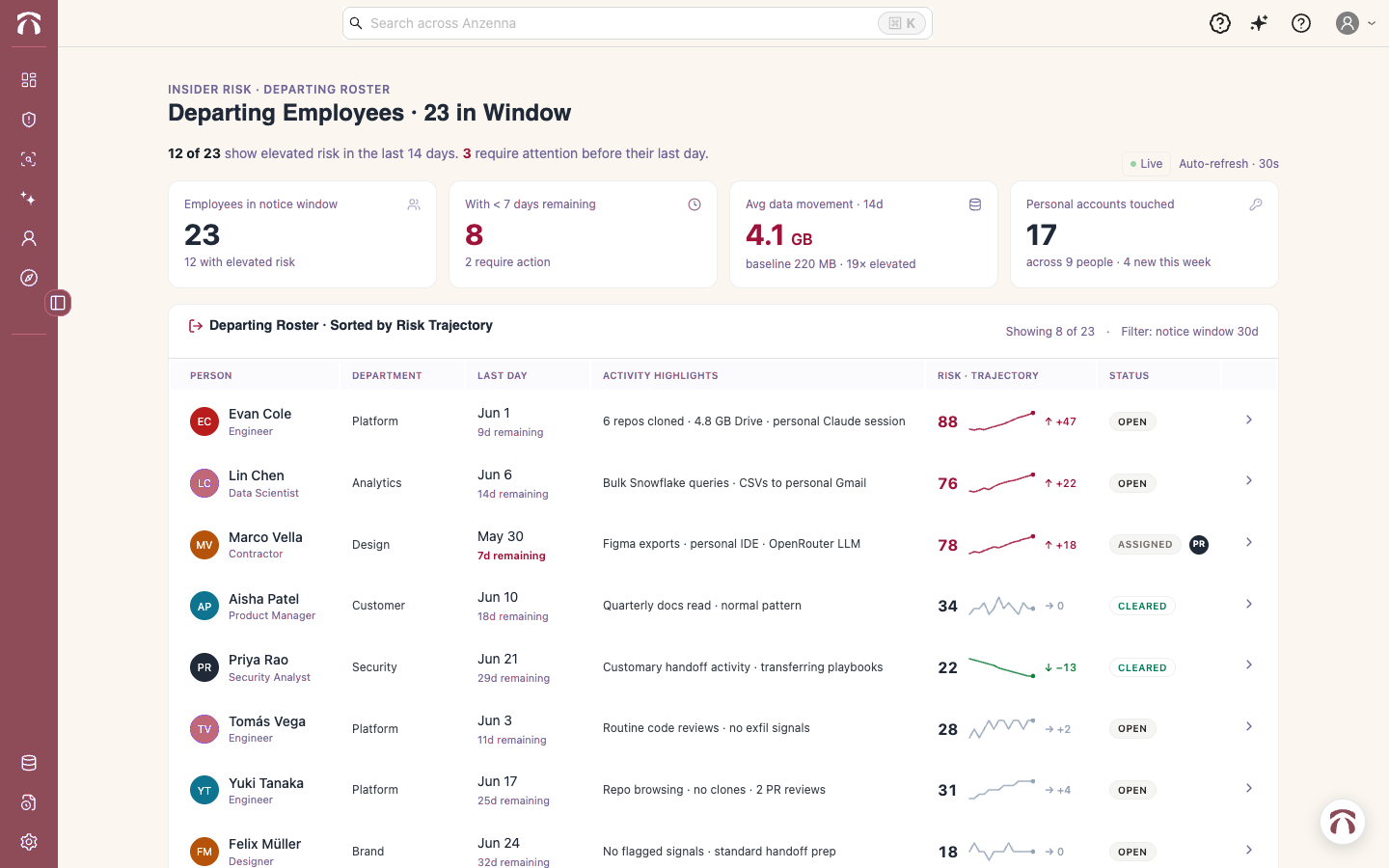
Twenty-three employees in notice. Twelve with elevated risk. Three need attention before their last day. Anzenna watches the whole roster, every day, so the team works the few that matter, not all of them.

A signal without context is only a fragment.
One file moves. One alert appears. On its own, it tells you very little. The surrounding pattern is missing: what came before, what changed, what else moved with it, and whether the action belongs. Without that wider frame, the signal stays fragmentary. It asks for attention, but offers no conclusion.
Risk without context becomes another queue.
Behavior rises above a threshold. A score follows. Then another. Soon the surface is crowded with flagged motion, but little sense of what truly matters. Context is what separates ordinary movement from meaningful deviation. Without it, the queue grows louder, not clearer.


Collection is not understanding.
The records are there. The sequence is not. A rule can gather what happened, but not why it matters, what changed around it, or whether it breaks from what is normal for that person in that moment. Insider risk is rarely a single event. It becomes visible only when the surrounding story is intact.

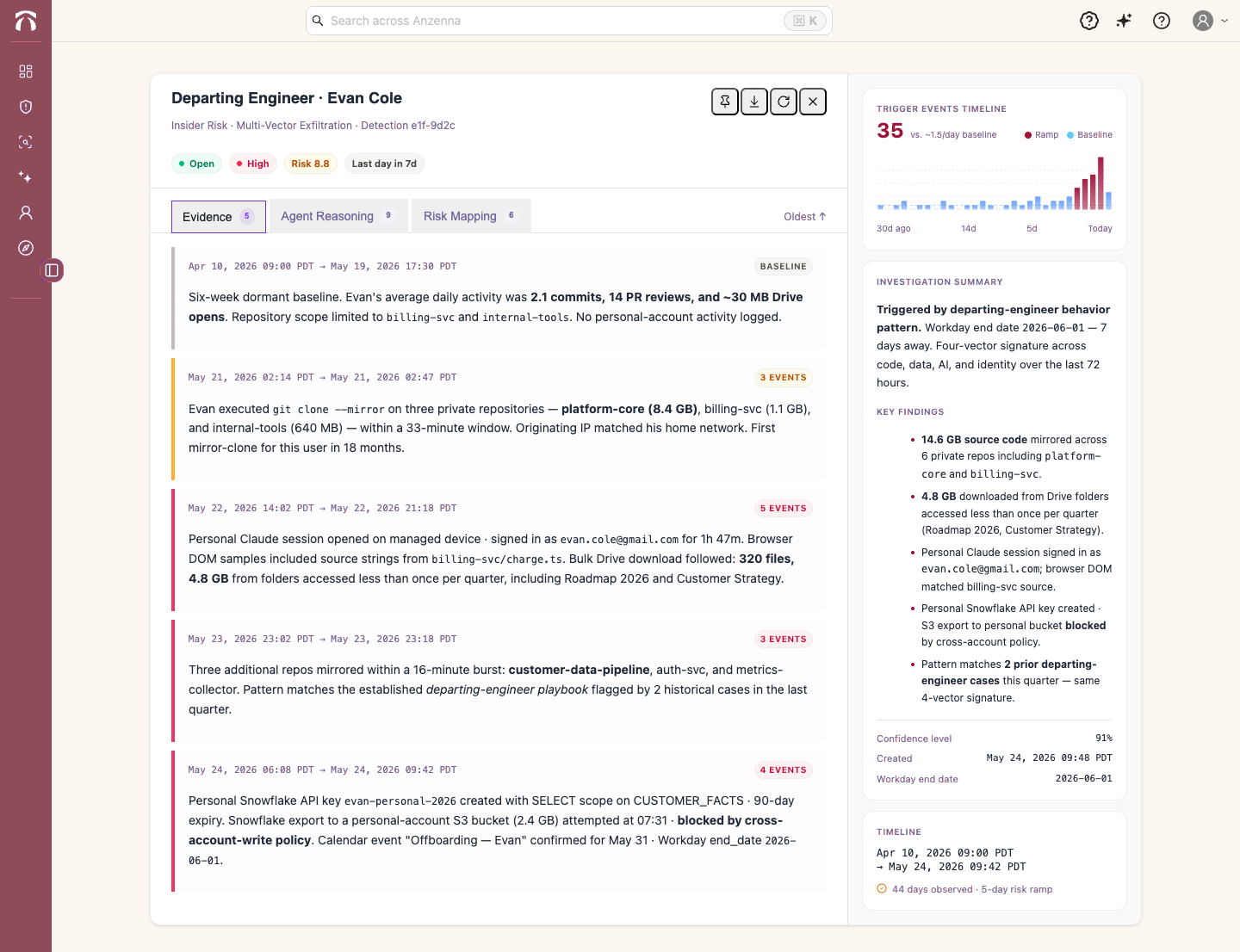
Every Anzenna signal arrives with its full frame: what came before and after, HR status, behavioral history, and peer comparison. A file transfer is not an alert on its own. It is one moment inside a complete investigation, assembled before an analyst ever opens the case.

Risk is measured against the comparison that actually matters: same team, same tenure, same projects. A score without a baseline is just more noise on the surface. The result is a small set of real cases, not a growing queue of flagged identities your team cannot meaningfully work through.

HR status, role, tenure, and departure signals are first-class inputs. Anzenna understands whether an employee gave notice yesterday, is on a performance plan, or recently changed roles. A SIEM cannot write that rule. Anzenna does not need to.
An insider incident is never a single moment. It is a path that starts weeks before any data moves. DLP and SIEM wake up at the end of that path, when the file is already leaving. Anzenna reads it from the beginning.
Notice given. A passed-over promotion. A recruiter's offer. Intent forms long before a single file is touched.
Repos cloned, rarely-opened Drive folders browsed, more pulled together than the role has ever needed.
Archives renamed, files zipped, history cleared, data staged toward a personal account.
The data finally leaves: a USB drive, a personal cloud, an upload. The loss is now real.
A twelve-gigabyte download means nothing until you know why it happened. Anzenna reads the intent behind a deviation, so the response fits the person, not just the event.
A departing engineer staging source code for a competitor. Deliberate, aware of the controls, working to stay under them.
A rushed employee emailing a client list to a personal account to finish over the weekend. No malice, but real exposure.
Valid credentials moving in unfamiliar ways. The account belongs to your employee. The hands on it may not.
Anzenna caught a four-million-dollar IP exfiltration three days before the employee's last day. Our old SIEM never would have seen it.
Fifteen-minute install. Read-only by default. No agents on endpoints.
Thirty minutes. Your environment, not our slides.
Request a walkthrough ↗